Home Blog Page 442

NHC Launches New ROV Course in Singapore

National Hyperbaric Centre has developed, an industry-first, ROV System Auditing and Assurance Course at their new facility in Singapore.

The course aims to provide technical and operational ROV personnel with knowledge to become aware of auditing processes, enabling technical progression in the industry as part of development of competence.

The three-day course combines practical and theoretical elements enabling delegates to become conversant with IMCA guidelines and industry requirements surrounding auditing techniques, procedures and technical reporting on contractor’s equipment.

NHC believes this course gives candidates a thorough grounding of auditing processes and technical aspects of offshore ROV systems and will improve the quality of audits, resulting in safer and more efficient systems.

Positive feedback was received from candidates who attended the first course at the new Singapore centre and further dates are currently being planned both in Singapore and Aberdeen.

Source

Inside BP’s Upstream Learning Center

BP plc’s latest Upstream Learning Center (ULC), located at the oil major’s UK headquarters at Sunbury-upon-Thames, just outside of London, aims to give the company more flexibility in how it trains its workforce around the world. Slightly smaller than BP’s Houston ULC, the Sunbury facility will help the firm to train its European-based staff as well as employees from further afield both on site and via remote learning.

After its completion this summer, BP invited Rigzone to take a look at the center – an offer we jumped at. The main foyer of the Sunbury ULC consists of a large space in which BP employees attending the facility can meet informally, as well as use various devices to help them learn about BP’s business.

For example, there is an interactive table that provides information and data about BP’s operations around the world. Visitors can also collect an iPad from the facility’s reception that they can use to point to items distributed around the foyer and – thanks to an augmented reality app – learn in detail about those items. For example, using the iPad, Rigzone learned about the different kinds of rock that BP wells encounter around the world. 

Chuck Russell, head of Infrastructure and Performance for BP Upstream Talent & Learning, was responsible for establishing the Sunbury ULC. Showing Rigzone around the facility, Russell seemed particularly keen on the informal networking and learning opportunities that the Sunbury ULC can offer.

“Prior to this, [learning] took place in hotel rooms and conference centers in southeast UK. So, by bringing people into this center, there’s a lot of cross-pollenization and the sharing of stories that wouldn’t otherwise happen. So we have HR in there along with Procurement & Supply Chain Management, Projects, Wells, etc. during the breaks before class starts and afterwards.”

The ULC is used to host on-site courses that typically last from three to 10 days, Russell explained.

“But we have a lot of half-day and one-day courses where we can use distance learning to deliver that content very cost-effectively,” he said.

For this reason, BP’s Distance Learning Classroom not only includes large video screens and several cameras but “green screen” technology so that lecturers can flash up important data for their students behind them while on camera.

 A centerpiece of BP’s new ULC is its Well Control Simulator. Every two years, well control professionals need to be certified either through the IADC (International Association of Drilling Contractors] or the IWCF (International Well Control Forum). BP, like Royal Dutch Shell plc, has decided to bring that training and certification in house.

“The industry standard is kind of the least-common denominator for land rigs, shallow water rigs and deep water rigs, and [because] much of what we do is in deep water we wanted to raise industry expectations, and raise our own expectations, around that certification process,” Russell explained.

“This is the Applied Deep Water Well Control Course. This is one where we bring our partners in as well … Those are high risk, high profile wells and we bring all of our teams in to face six of the most harrowing scenarios they may ever face in their careers.”

BP’s people running the simulator can “unleash Armageddon at any time”, so problems that drillers using the simulator might face can include multiple down-hole problems linked to surface issues such as equipment failures. The drill can get stuck, with drill bits blunted, and nozzles can be lost. This is part of what Judith Luberski, HR vice president for BP’s Production Division, describes as BP’s “learning-by-doing” approach that relies on the “70-20-10” philosophy.

“The theory is that 70 percent of how people learn is on the job: what they do every day, the types of experiences they get, the structure of the roles they are hired to do. Twenty percent is more around networking/social learning and 10 percent we classify as formal learning,” she said.

 “The well simulator… is where we try to blend that experience of what people would do on the job with being in a formal classroom.

“Simulation allows you … to practise and get into something much more quickly. And I think that will help us, to some extent, accelerate capability development and pull capability through faster than perhaps we’ve done historically.”

Another key component of making sure that useful learning takes place is to have teachers at the ULC who really do know what they are talking about.

“We work to leverage our own capabilities. So, many of the faculty members who lead and teach programs are BP employees. And we think there is a real value in that in terms of knowledge transfer and knowledge sharing. It equips some of our leaders to perhaps do things they wouldn’t normally do in an oil and gas company.”

OneSubsea Nets 10-Year BG Deal

0

OneSubsea™, a Cameron and Schlumberger company, has signed a 10-year global frame agreement with BG Group to supply subsea production equipment and aftermarket services.

By adopting OneSubsea’s unique integrated solutions capabilities, the agreement establishes a framework for BG to pursue a standardized approach to subsea production technology and services for their new field development portfolio on a worldwide basis.

OneSubsea Chief Executive Officer Mike Gardingsaid, “We are extremely pleased to be collaborating with BG Group to support their subsea field development objectives on a global scale.  Through this long-term framework agreement, OneSubsea will engage the  competencies of our Integrated Solutions team, providing engineering expertise, reliable field-proven technology, and aftermarket services to meet BG’s new development goals.  Having supplied more than 100 trees to-date, this further cements our well-established relationship with BG.

Source

Asia Leads in Global LNG Demand Growth, China Support

0

Fast expanding Asian economies, with rising energy needs, will emerge as a key driver for demand growth in the global liquefied natural gas (LNG) market over the next few years, with China accounting for the bulk of the increase. The LNG demand growth in Asia comes at a time when producers – in North America, East Africa or Canada – cast their eyes on potential markets in the region.

SOARING ASIAN LNG DEMAND

Global natural gas demand is expected to rise by 20 percent from 2013 to 2019, Jerome Ferrier, president of International Gas Union (IGU) and senior vice president for Corporate Security at Total S.A., told the 6th World LNG Series – Asia Pacific Summit in Singapore last month.

Hess To Form MLP For North Dakota Oil, Gas Transport Assets
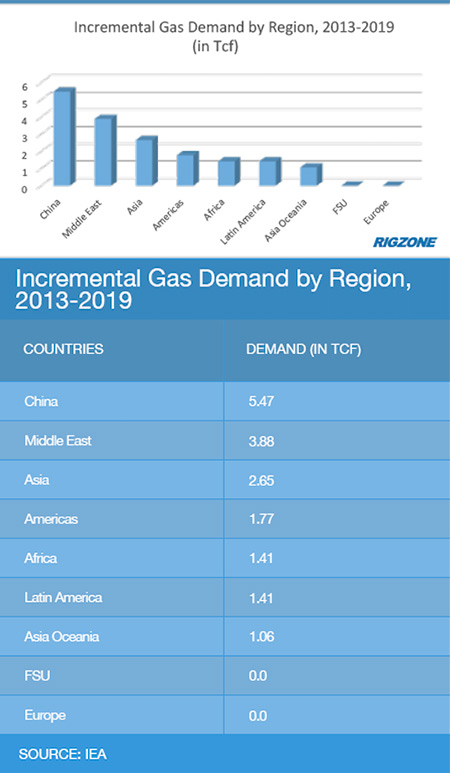
Incremental gas demand by region, 2013-2019

China alone accounts for around 31 percent of global gas demand growth during this period, according to data from the International Energy Agency (IEA), while Asia – including China and Oceania – will collectively contribute 52 percent of the increase. IEA forecast that natural gas demand worldwide will grow around 17.66 trillion cubic feet (Tcf) or 500 billion cubic meters (Bcm) from 2013 to 2019.

“Global natural gas demand is expected to increase by 20 percent over 2013-2019 with Asia – primarily China – growing the fastest while European demand is expected to stay below 2010 levels. Global gas demand grew by 17.66 Tcf (500 Bcm) over the period which is equivalent to European Union’s natural gas consumption in 2013,” Ferrier said in his speech.

Strong demand for energy to power the world’s second largest economy coupled with a desire to improve air quality are expected to raise China’s consumption of clean fuels such as natural gas. Gas is poised to play a bigger role in China’s primary energy mix, with the fuel’s share rising from 4.5 percent in 2011 to 7.5 percent in 2015 under the 12th Five Year Plan.

The U.S. Energy Information Administration (EIA) expects Chinese gas demand to increase to 7.8 Tcf in 2020 and 17 Tcf by 2040. Beijing is expected to continue with gas imports through LNG and via new and proposed import pipelines from neighboring countries, including Russia, which penned a $400 billion deal in May to supply gas to China.


Hess To Form MLP For North Dakota Oil, Gas Transport Assets
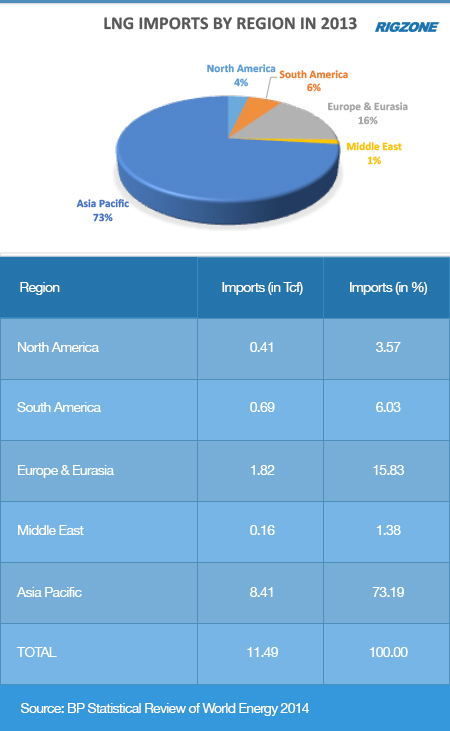
LNG Imports by Region in 2013

“China is becoming the largest gas consumer in the region, almost doubling its consumption between 2010 and 2018 … [while] Asia has overtaken Europe as the world’s largest gas importer accounting for 46 percent of global LNG trade,” the IGU president commented.

Natural gas trade in Asia Pacific is now dominated by LNG and the region is likely to secure further supplies from the 4.59 Tcf (130 Bcm) that will be produced from 12 ongoing LNG projects currently under construction, Ferrier added.  

LNG SUPPLIERS EYE MARKETS IN ASIA

Growing Asian demand and stagnant European consumption have encouraged potential gas suppliers, including those in North America, to seek new markets in Asia Pacific. The North American shale gas boom has substantially changed the landscape shifting the continent from an LNG import play to an LNG export one, the IGU observed.

In the United States, several firms benefiting from the shale gas boom are keen to export LNG as foreign buyers pay more for the fuel. Last year, North American gas price “continued to trade at a deep discount to European and Asian markets … In economic terms, the Asian destinations seem more attractive for U.S. LNG producers than the EU ones,” Ferrier added.

Some U.S. companies have already secured several LNG supply deals. In early 2012, Indian and South Korean firms agreed to purchase .423 Tcf  (12 Bcm) of LNG annually from the U.S. Gulf Coast beginning 2015/2016, while a few Japanese trading houses and utilities agreed to acquire a little over .706 Tcf (20 Bcm) yearly from three U.S. LNG export projects – Cameron LNG, Cove Point LNG and Freeport LNG.

In Canada, Malaysia’s national oil company Petroliam Nasional Berhad (Petronas) hopes to make a final investment decision (FID) on the Pacific Northwest LNG (PNW LNG) project in British Columbia by mid-December. Petronas intends to develop shale gas assets under the project and build an LNG export terminal in British Columbia to ship supplies to Asia.


Whether Petronas proceeds with development of the PNW LNG project will hinge on the firm making the FID by the stipulated timeline. The company is now working with government agencies to advance the regulatory process and clarify the fiscal framework associated with the LNG industry in Canada, Petronas said in an Oct. 8 press release.

“The reality of the global LNG market is that we are facing potential overhang and decreasing demand that creates downward pressure on LNG prices. In this market environment, the ability to secure market and customers is paramount … Coupled with softening crude prices, there is a need for … Petronas to seriously prioritize and reassess our investments,” Shamsul Azhar Abbas, Petronas president and Group CEO said.

North American LNG exports from the United States and Canada to Asia may reach as much as 1.76 Tcf (50 Bcm) per year in 2025, with the volume meeting around 14 percent of the region’s total demand. However, most of the new LNG supplies to Asia will come from Australia, which is expected to provide a quarter of the region’s requirements in 2025, with additional supplies coming from East Africa, including Mozambique.

SINGAPORE PREPARES FOR A BIGGER LNG ROLE IN ASIA

Singapore is leveraging on its geographical location in Asia and existing role as a major oil trading center to position itself as the region’s LNG hub. The Singapore government, which funded construction of the Singapore LNG Terminal that commenced operations in May 2013, revealed plans to build additional infrastructure to support the island-state’s ambition to be Asia’s LNG hub.

In this regard, Singapore LNG Corporation Pte Ltd. (SLNG) – the government-owned operator of the terminal located on Jurong Island – inked a $560 million (SGD 700 million) engineering, procurement and construction contract in August with Samsung C&T Corporation. The contract, involving the addition of a fourth LNG storage tank and regasifcation facilities, will expand throughput capacity at the terminal to about 11 million tons per annum (Mtpa) in 2017, up from an existing 6 Mtpa.

“We are … turning the next page of the Singapore LNG story, as we build up the Terminal’s capacity to allow Singapore to respond to new business opportunities in the regional or global LNG markets,” John Ng, CEO of SLNG said in a company announcement.

Earlier in February, Singapore Prime Minister Lee Hsien Loong outlined plans to construct the country’s second LNG terminal in the eastern part of the country to enhance energy security, grow the local LNG industry and support the development of ancillary services like LNG trading, bunkering and vessel cool-down services. 

“The Jurong Island LNG terminal … is the only terminal in Asia that can reload cargoes … thus supporting the emergence of Singapore as a major Asian trading hub and market place … with its unique location between producers such as Indonesia, Malaysia, Australia, the Middle East countries and consumers such as China, India, Japan, Korea and Thailand,” Ferrier said.

But Singapore faces competition from Japan – the world’s largest LNG importer – in its quest to become an Asian LNG hub.

“Japan will take the lead in developing an Asian LNG Hub. Discussions on the establishment of LNG futures market in Japan have begun … [while attempts are being made to address issues such as] improvement in the reliability of prices, and increase in the volume of physically traded LNG [which] is essential to the development of such markets,” Tatsu Nishimura, deputy-director, Oil & Gas Division at Japan’s Ministry of Economy, Trade and Industry told conference participants.

Looking ahead, the “sharp inflation in the unit cost of liquefaction projects between 2008 and 2014 – a period when oil prices have been stagnating – is hampering the decision making process of the new grassroot eastern African and eastern Mediterranean LNG development projects,” Ferrier observed. 

Liquefaction unit cost of construction for projects like Gorgon LNG in Australia rose to $1,800 a ton of capacity per year in 2014, compared to around $400 for Qatargas 3 project in 2010, the IGU noted, citing data from the Oxford Institute for Energy Studies.

Still, LNG projects in East Africa and East Mediterranean are progressing gradually.

In East Africa, Anadarko Petroleum Corp. is working to develop a commercial LNG project in Mozambique to export gas produced from the country’s deepwater Rovuma Basin’s Offshore Area 1 Block in 2018. The Area 1 block has an estimated reserves of 50 to 70 Tcf of recoverable natural gas. 

Meanwhile, Noble Energy Inc. submitted a preliminary development plan for the eastern Mediterranean Sea’s Leviathan natural gas project to Israel’s Energy Ministry for approval Sept. 30. The Leviathan project, which a Reuters report indicated would cost around $6.5 billion to develop, contains gas reserves of around 21.96 Tcf (622 Bcm).

Source
NOAA Discovers Two WWII Vessels Off North Carolina

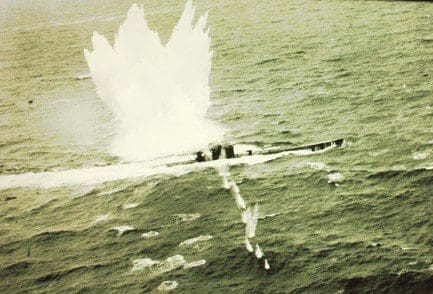
A team of researchers led by NOAA’s Office of National Marine Sanctuaries have discovered two significant vessels from World War II’s Battle of the Atlantic. The German U-boat 576 and the freighter Bluefields were found approximately 30 miles off the coast of North Carolina.

Lost for more than 70 years, the discovery of the two vessels, in an area known as the Graveyard of the Atlantic, is a rare window into a historic military battle and the underwater battlefield landscape of WWII.

This is not just the discovery of a single shipwreck,” said Joe Hoyt, a NOAA sanctuary scientist and chief scientist for the expedition. “We have discovered an important battle site that is part of the Battle of the Atlantic. These two ships rest only a few hundred yards apart and together help us interpret and share their forgotten stories.”

On July 15, 1942, Convoy KS-520, a group of 19 merchant ships escorted by the U.S. Navy and Coast Guard, was en route to Key West, Florida, from Norfolk, Virginia, to deliver cargo to aid the war effort when it was attacked off Cape Hatteras. The U-576 sank the Nicaraguan flagged freighter Bluefields and severely damaged two other ships. In response, U.S. Navy Kingfisher aircraft, which provided the convoy’s air cover, bombed U-576 while the merchant ship Unicoi attacked it with its deck gun. Bluefields and U-576 were lost within minutes and now rest on the seabed less than 240 yards apart.

“Most people associate the Battle of the Atlantic with the cold, icy waters of the North Atlantic,” saidDavid Albergsuperintendent of NOAA’s Monitor National Marine Sanctuary. “But few people realize how close the war actually came to America’s shores. As we learn more about the underwater battlefield, Bluefields and U-576 will provide additional insight into a relatively little-known chapter in American history.”

The discovery of U-576 and Bluefields is a result of a 2008 partnership between NOAA and the Bureau of Ocean Energy Management (BOEM) to survey and document vessels lost during WWII off the North Carolina coast. Earlier this year, in coordination with Monitor National Marine Sanctuary, NOAA Ship Okeanos Explorer conducted an initial survey based on archival research. In August, archaeologists aboard NOAA research vessel SRVX Sand Tiger located and confirmed the ships’ identities.

This discovery highlights the importance of federal agencies working together to identify and protect these unique submerged archaeological resources that are of local and international importance,” said William Hoffman, a BOEM archaeologist.

The newly identified wrecks are protected under international law. Although Bluefields did not suffer any casualties during the sinking, the wreck site is a war grave for the crew of U-576.

In legal succession to the former German Reich, the Federal Republic of Germany, as a rule, sees itself as the owner of formally Reich-owned military assets, such as ship or aircraft wreckages,” said the German Foreign Office in a statement. “The Federal Republic of Germany is not interested in a recovery of the remnants of the U-576 and will not participate in any such project. It is international custom to view the wreckage of land, sea, and air vehicles assumed or presumed to hold the remains of fallen soldiers as war graves. As such, they are under special protection and should, if possible, remain at their site and location to allow the dead to rest in peace.”

United States policy on sunken state vessels, such as these, reaffirms sovereign government ownership of the wrecks, including German ownership of U-576. As stated in the 2001 Presidential Statement on United States Policy for the Protection of Sunken State Craft the wrecks are not considered abandoned nor does passage of time change their ownership.

The United States will use its authority to protect and preserve sunken State craft of the United States and other nations.

Other partners who participated in this effort include: NOAA’s Office of Exploration and Research; the National Park Service American Battlefield Protection Program and Submerged Resource Center; East Carolina University, the University of North Carolina Coastal Studies Institute; and SRI International.

As part of the NOAA Battle of the Atlantic Research Project, extensive discussions took place with others including consultation with both Great Britain and Germany as well as the United States Navy and United States Coast Guard. State of the art marine technology provided high-resolution sonar imagery to corroborate historic and archival accounts of the final location and characteristics of each vessel.

Source

Chevron Finds Paleogene Exploration Success with Guadalupe

0

Chevron Corp. reported Thursday that it encountered significant oil pay in Paleogene age Wilcox sands at the Guadalupe prospect in the deepwater U.S. Gulf of Mexico. The discovery adds momentum to Chevron’s growing North America business as the company continues to unlock important Gulf resources with its deepwater exploration and appraisal program.

The company started drilling the well in June with the Discoverer India (UDW drillship). Drilled in 3,992 feet of water, the well reached a total depth of 30,173 feet. More tests are being conducted on the well, and additional appraisal activity will be needed to determine the resource’s extent, said partner BP plc in an Oct. 23 press statement. The well is located approximately 180 miles offshore Louisiana.

“This discovery further demonstrates Chevron’s exploration capabilities,” said George Kirkland, vice chairman and executive vice president for Upstream at Chevron, in an Oct. 23 press statement. “Guadalupe builds on our already strong position in the deepwater U.S. Gulf of Mexico, a core focus area where we expect significant production growth over the next two years.”

BP, which has made three discoveries in the emerging Paleogene trend in the deepwater Gulf, including Gila in 2013, Tiber in 2009, and Kaskida in 2006, said the Guadalupe discovery again highlights BP’s strength in exploration and the company’s commitment to the U.S. Gulf, said Richard Morrison, regional president of BP’s Gulf of Mexico business, in a press release.

BP Exploration & Production Inc. holds 42.5 percent working interest in the discovery well. Chevron U.S.A. Inc. is operator with 42.5 percent interest, and Venari Resources LLC holds 15 percent interest.

Chevron, which ranks among the top producers and leaseholders in the Gulf of Mexico, averages net daily production of 143,000 barrels of crude oil, 347 million cubic feet of natural gas, and 15,000 barrels of natural gas liquids this year, said Jeff Shellebarger, president of Chevron North America Exploration and Production Company, in a press statement. The company also expects to add to that volume with the production from the Tubular Bells and Jack/St. Malo projects by year-end. 

CRACKING THE PALEOGENE: NEXT MAJOR GULF CHALLENGE

Cracking the code of the Paleogene play poses the next major challenge for oil and gas companies operating in the Gulf of Mexico. The deepwater Gulf still contains significant untapped oil and gas resources, but the industry must find ways to achieve the productivity it needs to justify the billion dollar investment required to tap these resources, a panel of industry officials told attendees at Hart Energy’s Gulf of Mexico Offshore Executive Houston conference last week.

To crack the Paleogene, Statoil intends to take the most promising technologies and tailoring them for the Gulf of Mexico to bridge the technology gap, said Ola Gussias, technology manager for U.S. Offshore at Statoil, during a roundtable discussion on striking the right balance in deepwater. The company is working on a thru tubing submersible pump system, which it will debut at the 2015 Offshore Technology Conference. The concept is not new, but the pump and system are, and offer great potential for the deepwater Gulf. Statoil also is pursuing ECD management to reduce drilling risk, mud losses and costs while improving the speed of operations. The company is currently testing this technology on a rig it’s operating.

Statoil has found that transferring to the Gulf technology developed for use elsewhere is not necessarily straightforward. But the company does have experience in high pressure, high temperature wells from the Norwegian Continental Shelf that is applicable to the Gulf.

BHP Billiton sees the biggest material game changing opportunities in the Gulf in and around the Miocene, said Stephen Pastor, asset president of conventional at BHP. To tap these opportunities, BHP is pursuing near-field exploration opportunities to take advantage of the cost benefits of existing infrastructure and applying technologies such as 4D seismic, enhanced oil recovery and water injection.

Over the next decade, Venari sees exploration and production in the Gulf moving further west and south as advances in seismic technology allow industry to see parts of plays not visible with technology five years ago. As a result, anticipates more infrastructure and subsea tiebacks in these areas, said Brian Reinsborough, president and CEO of Venari.

Despite cost increases, investor appetite for the deepwater Gulf remains strong due to its great oil potential and high margin business, said Reinsborough. 

The industry could and needs to do a better job of predicting costs for large projects. Instead of over-engineering like it tends to do, oil and gas companies should seek to standardize operations where possible. Oil and gas companies also tend to drill too many wells, and need to strike a fine balance in understanding fields properly while not destroying a field’s value. The industry needs both innovation and standardization, said Reinsborough. He points to Anadarko Petroleum Corp.’s spar developments in the Gulf has an example of standardization from which industry could learn. 

Water depth in itself no longer poses a significant challenge in terms of deepwater exploration.

“The rigs and the drilling capacity are there,” said James H. Painter, executive vice president, execution and appraisal, with Cobalt International Energy Inc.

Instead, the Gulf’s geological challenges such as high pressure and high temperature will be the toughest to solve. Other problems that industry must address include structural and process costs associated with deeper wells, rising costs for field development, and deepwater currents.

Despite the challenges, officials remain confident that industry will find a way to solve these problems.

Source

Eni Norge to Drill for Oil Spill Response in the Dark

0

Eni Norge is entering into an oil spill contingency training agreement with the Nordkapp Maritime Training Centre in Honningsvåg.

The centre will be the first in the world to employ simulators for oil recovery training in conditions of darkness.

The development of the Goliat field has considerably strengthened the oil spill contingency apparatus in West Finnmark, which is tailored to a large extent to conditions prevailing along the Finnmark coast. The Goliat contingency strategy can be employed for incidents on both local and national scales, regardless of whether the source of the discharge is a vessel or an offshore installation. The new agreement is an extension of this strategy, and is part of its continuous improvement.

The monitoring and recovery of oil in conditions of darkness are issues that Eni Norge has been working to address for many years. The Nordkapp Maritime Training Centre has state-of-the-art simulators enabling the simulation of both the discharge and recovery of oil under demanding conditions, including in darkness. This is of special significance in the Arctic, where there is very little daylight during the winter.

The centre will also train both onshore and offshore personnel in how to obtain a joint situational understanding during a potential incident.

The contract with the Nordkapp Maritime Training Centre has three parts:

– Courses and training in oil spill contingency response;

– Courses in towing to the crews of the standby vessel Esvagt Aurora and other vessels used by Eni Norge in connection with the Goliat project. This will involve training the crews in how to remove vessels which may be drifting on a collision course with the Goliat platform;

– Courses in team coordination and training for personnel manning the Goliat platform, standby vessels and shuttle tankers to enable them to carry out loading and offloading operations to and from the platform as safely as possible.

The contract extends from 1 November 2014 for a period of three years, and contains a 2 + 2-year extension option.

Goliat will be the first oil field to come on stream in the Barents Sea. The field is being developed using a floating production, storage and offloading platform (FPSO), and is planned to come on stream in the middle of 2015.

Source

Treasure hunter uncovers Bronze Age settlement using Google Earth

Real life Indiana Jones – Howard Jones- discovered ancient treasures using simple technology.

A treasure hunter has stunned archaeologists by locating an historic Bronze Age settlement – using just Google Earth.

Canny Howard Jones shunned his usual methods of finding ancient communities – and simply used the internet instead.

He trawled satellite images for the sort of terrain that would have offered food, water and shelter for a prehistoric settlement.

Howard used Google’s overheard mapping site to zoom in on fields and farmland before pinpointing a spot in South Hams, Devon.

The former Royal Marine then sought permission from the local landowner before heading down there to scour for remains.

To his amazement he soon unearthed old flint tools, pottery shards and scraps of metal thought to date back 5,000 years.

Thrilled Howard called in Devon County archaeologist Bill Horner who carried out a geophysical survey using ground-penetrating radar equipment.

The two men soon found two large buried structures that they believe are farm buildings dating back to the bronze or iron age.

Howard, a commercial diver from Plymstock, Devon, said: “Night after night I looked at Google Earth asking myself the question ‘if I was alive 3,000 years ago where would I live’.

“I would need food, water, shelter, close to Dartmoor for minerals, close to a river to access the sea and trade routes.

“After a few weeks I put an ‘X marks the spot’ on the map – that was where I would live.”

Not knowing who the site belonged to, Howard was initially unable to test his theory until he tumbled across the landowner by chance.

He said: “At kids rugby training one night I remembered that one of the other coaches was a farmer and I asked him if I could field walk and detect on his land.

“As I didn’t know where his farm was, I arranged for my family and I to meet him and he gave us a tour of his fields.

“It was then I found out that my ‘X marks the spot’ was on his land – it was unbelievable.”

Howard has previously searched for ancient artifacts underwater and in 2010 he was involved in the discovery of the 300-year-old Dutch merchant vessel the Aagtekerke off the Devon coast.

But after deciding to switch his search inland because of this year’s storms he hopes his latest find will prove his best yet.

Mr Horner has arranged for a series of trench digs, which could take place as early as February next year.

He says Howard’s web-inspired find could offer new insights into Bronze Age trading outposts.

Mr Horner said: “The survey shows two or three probable farmsteads which look to be late prehistoric, bronze age to iron age.

“Other parts of the underlying settlement possibly continue to the Romano-British period, around 1,500-2,000 years ago.

“The images also show tracks and enclosures, as well as a number of pits, which alongside Howard’s findings, looks like evidence of metal works.”

“We know that Devon’s mineral resources were being traded along the coast and along the channel in prehistoric times.

“While Dartmoor is famous for preserved historic sites, the same is not true of coastal areas. So this could be the missing link between those moorland sites and the evidence we have of trading.”


GDF, BP Make ‘Significant’ Discovery in the UK North Sea

GDF Suez and BP announced Thursday that they have made a “significant” discovery in the UK zone of the central North Sea. The discovery spans the GDF-operated block 30/1f in license P1588 and the BP-operated block 30/1c in license P363. Dubbed “Marconi” by GDF and “Vorlich” by BP, the discovery has been flow-tested at a maximum rate of 5,350 barrels of oil equivalent per day. A BP spokesperson told Rigzone that the company was being cautious about giving a precise figure as to the size of the discovery, but that it was “significant”.

In a company statement, GDF Suez E&P UK Managing Director Ruud Zoon commented: “This is an encouraging exploration discovery in a part of the Central North Sea that needs additional volumes of hydrocarbons to open up development options for several stranded discoveries. The discovery is our third successful well this year and demonstrates a continuing commitment by GDF SUEZ to an active exploration and appraisal drilling program on the UK Continental Shelf.”

In a separate statement, BP North Sea Regional President Trevor Garlick said: “As BP marks its 50th year in the North Sea and as the industry looks to maximize economic recovery from the basin, increasing exploration activity and finding new ways to collaborate will be critical to realising remaining potential. This discovery is a great example of both.”

The discovery was found with exploration well 30/1f-13AZ encountering hydrocarbons in a Palaeocene sandstone reservoir in block 30/1c and a subsequent side-track well in block 30/1f confirming the westerly extension of the discovery. Drilling was done by GDF using the rig Transocean Galaxy II (400′ ILC). 

Source

Vesper Marine Beacons Used in MH370 Hunt

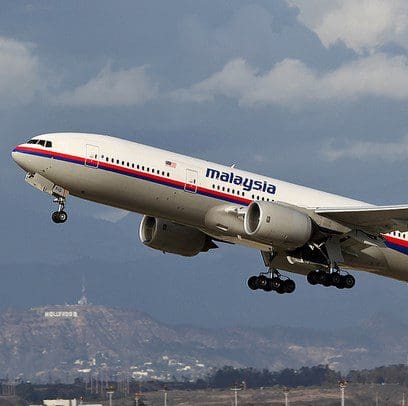
Vesper Marine’s Virtual AIS Beacons are employed in the search for lost Malaysian airliner MH370 in the southern Indian Ocean.

The international search team is a closely coordinated effort between United States-based Phoenix International, Dutch engineering company Fugro and the governments of Australia and Malaysia.

After an exhaustive period of mapping the ocean floor, the on-the-water search is focused on an area of ocean roughly twice the size of Massachusetts. Salvage vessels have deep-water, side-scan sonar arrays in tow at depths of approximately four miles below the surface and 300-500 feet above the seafloor. To reach these depths, a six-mile long tow cable is required. Vesper Marine’s Virtual AIS Beacons are used aboard each of the search vessels to virtually mark the cable and sonar arrays to provide electronic visibility and prevent other surface vessels and sub-surface tows from colliding with the equipment.

A virtual ATON is created when a special ATON signal is transmitted from one location to mark another remote point. The Vesper Marine Virtual AIS Beacons used in the search send signals that are received by existing AIS units installed on all large vessels operating in international waters. AIS marks will be displayed along the length and width of the tow cable on the receiving boats’ ECDIS, chart plotters and other AIS displays. Nearby vessels’ onboard electronics alert crews if they are on a collision course with the marked navigational hazard allowing them to change course and avoid the search equipment.

“The terrible tragedy of MH370 has touched the world and for the families and loved ones of those lost we all want the search to be conducted in the safest way possible,” said Jeff Robbins, CEO, Vesper Marine. “An operation of this scale and complexity involves many people and sophisticated technologies. We are proud that our Virtual AIS Beacons have been chosen to enhance safety during the search and we are honored to be part of the effort.”

Source