Home Blog Page 441

Maersk Venturer Drills for Total Off Malaysia

0

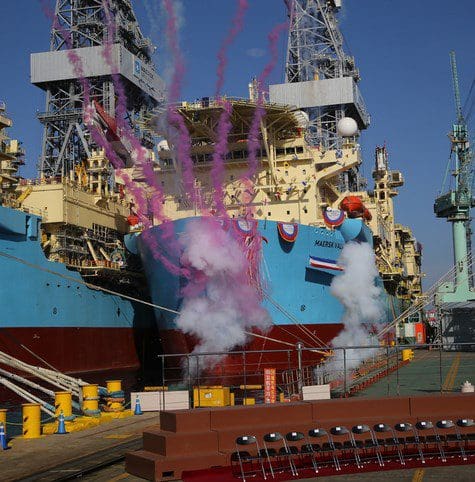
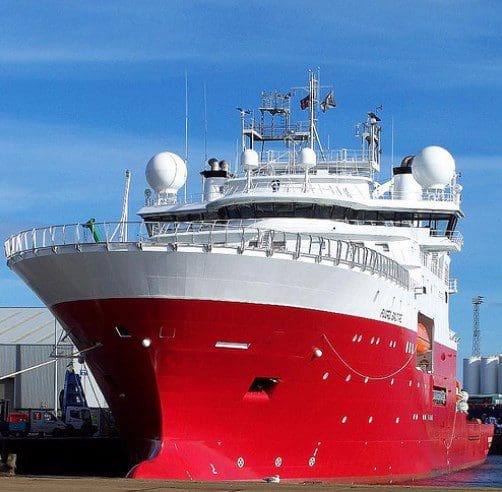
Maersk Drilling’s third drillship, Maersk Venturer, which was delivered September 25, 2014 from the Samsung Heavy Industries (SHI) shipyard in Geoje-Si in South-Korea, has secured a short term contract with oil major Total.

Maersk Venturer will start a one well programme offshore Malaysia with an estimated duration of 45 days with potential extension up to 40 days. The drilling programme is expected to start in December 2014 following acceptance testing. The estimated revenue from the firm 45 days period is USD 17 million.

“Total is a highly valued customer of Maersk Drilling and we see the contract award as a reflection of our long and good collaboration over the years. We are happy to get the Maersk Venturer out working, especially with the short term challenges in the floater market, and we remain confident that we can secure another good contract for the drillship, when this short term contracts ends,” saysClaus V. Hemmingsen, CEO in Maersk Drilling and member of the Executive Board in the Maersk Group.

Maersk Ventuer is the third in a series of four ultra deepwater drillships to enter Maersk Drilling’s fleet. The four drillships represent a total investment of USD 2.6 billion and will be delivered from the SHI shipyard in 2014. The drillship features dual derrick and large subsea work and storage areas, and its design allows efficient well construction and field development activities through offline activities.

Source

Deep Sea Adventures, travel underwater

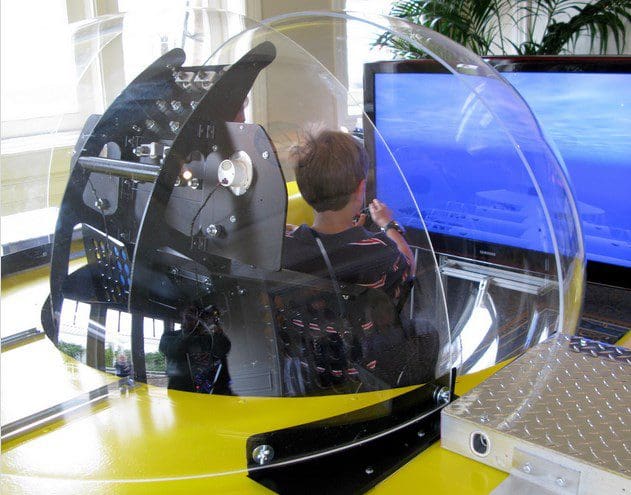
Ever wondered how it would be like to travel by a submarine and to explore the vastness of the ocean 1000 feet beneath the surface? Well, this adventure is not far from possible. A team consisting of three people from West Palm Beach can take you to a ride of your life in their 23 feet long submarine.

The submarine was built in 1976 and still operational to this day thanks to the efforts of Robert Wicklund (commercial diver/boat builder), William Neunzig (retired beach firefighter/boat captain/marine engineer) and Patrick Lahey (Triton Submarines president) for maintaining the good working condition of the submarine. The vessel can be used for commercial activities such as treasure hunting and deep-sea exploration. A Triton sub such as this costs approximately 3M US dollars.

The certified sub has been restored and can accommodate a pilot and two passengers. It is equipped with a huge propeller and a bank of batteries is its primary energy source. The ship can cruise for a good 12 hours per charge and can travel at a speed of 1-4 knots regardless of the current. It also has a backup emergency life support system that can last up to one week.

“We could set up for treasure hunting. We can do science stuff. It can adapt to all kinds of different jobs underwater,” Neunzig said. “I’m fascinated by going on different adventures and when you show up with a submarine, people get so excited.

Some of the recent assignments that the ship has done were the exploration of a shipwreck in Norfolk, aiding a TV documentary and leasing the sub to a rich family for travels underwater in Antarctica. The lease rate is 7,500 USD daily with three crew and support equipment comprised in the package.

Deep Sea Adventures, the company that owns the sub, enjoys maximizing the ship’s potential so three-man team make sure it’s always in good shape and keep it at optimum performance. For inquiries, visit:  http://www.deepseaadventures.com/


Fisher attorney claims more closed marine areas has already been decided, federal sanctuary official calls it ‘absurd’

A prominent Key West attorney this week launched a barrage of verbal volleys about the process to update rules in the Florida Keys National Marine Sanctuary.

“They have already made their decisions” on new marine protected areas, David Paul Horan said Thursday from Key West.

“These are areas up to 25 square miles where there will be no recreational or commercial diving or fishing,” Horan said. “They’ll close it forever. The only thing you can do is drive your boat across.”

No decisions have been made about any possible closures in the ongoing process to update the sanctuary’s management plan, the first major update since the current plan was created in 1997.

Horan, representing a group of Key West charterboat fishermen, spoke at a Wednesday meeting of Key West Chamber of Commerce and a Tuesday meeting of the Keys Sanctuary Advisory Council on Duck Key.

Horan said he suspects a controversial set of maps drafted in mid-2013 by members of a Sanctuary Advisory Council working group provide a blueprint for future plans.

Marine sanctuary managers insist nothing has been decided about marine zones or regulations for the sanctuary’s management plan.

“There are no secret maps,” sanctuary Superintendent Sean Morton said Friday. “There have been hundreds of proposals put out, but no one has yet recommended any proposal over another. Everything is being analyzed.”

“This has been an incredibly open process with a lot of meetings,” said Billy Causey, southeast U.S. and Caribbean regional manager for national marine sanctuaries after decades as the Keys sanctuary superintendent.

“All the information is up [on the sanctuary website] for people’s review. It’s all public,” Causey said Thursday. “It amazes me that after doing all this, some people think we’re hiding something. It’s absurd.”

Causey and Horan have often disagreed over sanctuary policy since federal legislation created the sanctuary in 1990.

Horan said Keys residents strongly supported rules to force ships to move away from the coral reef to prevent devastating groundings. Three large ships grounded on coral within weeks in late 1989.

“Basically we were asking for a glass of water and got an atomic weapon” in the form of the Keys sanctuary, Horan said.

Horan, best known for winning Mel Fisher’s case against the federal government over recovered shipwreck treasure, contends the sanctuary is using ecosystem-protection rules as a way of managing fisheries.

Morton and Causey said some regulations, like acting to ban wire fish traps in sanctuary waters, do affect fishing but are not fishery management.

Proposals for the management plan are undergoing state and federal review. The first set of draft alternatives, which legally require a no-action alternative, are expected to be released in summer or fall of 2015.

Source

BHP Billiton Eyes Sale Of US Shale Gas Assets In Profit Drive

BHP Billiton is planning to sell its Fayetteville shale gas assets in the United States, the mining and energy group said on Monday, in the latest effort to trim its portfolio in the region and focus on more profitable petroleum liquids. The petroleum division of BHP, the world’s largest miner, is one of the largest foreign investors in the U.S. onshore oil and gas sector. The unit has grown in importance within BHP in the least few years, thanks to a market outlook that has been brighter for energy than for other commodities.

Within the petroleum business, however, BHP has made it clear it intends to focus on liquid products in the United States, a more lucrative business than dry gas. Chief Executive Andrew Mackenzie, a former BP executive, told investors that the company had begun “marketing” the Fayetteville acreage, which it bought in 2011 but wrote down by $2.8 billion a year later after gas prices fell.

“The chances for us to develop it in the near term are very low to non-existent, and therefore it should be worth a lot more to someone… who is more obviously a natural owner,” he said.

The sale will only go ahead if BHP gets offers above an undisclosed floor price, the company added during its presentation to investors in London. BHP will, however, develop the Haynesville shale in Louisiana, which it says is a higher-return project. 

IN AND OUT

BHP moved heavily into U.S. shale in 2011, acquiring the Fayetteville assets from U.S. energy group Chesapeake for $4.75 billion and Petrohawk Energy a few months later for about $12 billion plus $3 billion in debt, just before a major downturn in U.S. natural gas prices. In 2012, the company was forced to take a hit on the value of Fayetteville which cost then chief executive Marius Kloppers his bonus. Chairman Jac Nasser defended the investment, but described the hit at the time as “very disappointing”.

“They are not going to sell it for a bargain price. Given the way the petroleum market has performed, it would have been easier to do this 12 months ago than today,” said Investec analyst Hunter Hillcoat. “But I think it’s a good quality assets so presumably they’ll find a buyer.”

BHP had said last year it wanted to sell roughly half its oil an gas acreage in the Permian Basin in Texas and New Mexico. It did not comment on that sale in Monday’s presentations. BHP announced in August plans to spin off operations worth roughly $16 billion – to focus on its most profitable activities in petroleum, iron ore, copper and coal.

The company is now focusing on cutting costs and boosting production from its core assets by 23 percent in the two years to the end of the 2015 financial year. It said it was on track to hit an output target for liquids from its shale business of 200,000 barrels per day in 2017.

“BHP is maintaining its message on petroleum. They have been quite clear they are going to invest $4 billion a year in onshore petroleum growth which is a big chunk of their committed growth,” Liberum analyst Richard Knights said.

Source

Eni Makes Gas Discovery Off Indonesia

0

Eni has made a gas finding in the Merakes exploration prospect, in the East Sepinggan Block, where Eni is operator with a 100% stake. The Block is located in the offshore East Kalimantan (Borneo), 170 kilometres south of the Bontang LNG Plant and 35 kilometres from the offshore Jangkrik field, also operated by Eni.

The finding was made through the Merakes 1 well which was drilled at a water depth of 1,372 metres and reached a total depth of 2,640 metres. The well encountered a significant accumulation of gas in the lower Pliocene clastic sequence. Merakes has crossed a hydrocarbon column of 60 metres in high quality sandstones.

Merakes is the first exploration well drilled by Eni in the East Sepinggan Block, which was assigned to the Company in 2012 following an International Bid Round. Merakes finding potential has been preliminary estimated to be 1,3 Trillion cubic feet of gas in place. The finding has further upside that will be assessed with a delineation campaign.

Claudio Descalzi, Eni’s CEO said: “This new success further implements the Company’s growth strategy in the Pacific Basin where, in addition to its presence in Indonesia, Australia and China, Eni recently signed new exploration contracts in Vietnam, Myanmar and China. Merakes finding is a significant one as it strengthens our position as operator in Indonesia. Moreover thanks to its proximity to the Jangkrik field, which is currently under development, this new gas finding could supply in the future additional gas volumes to the Bontang LNG plant. This new achievement proves once more the effectiveness of Eni’s strategic approach to exploration, which is based on operating with elevated stakes in exploration phase to better valorize exploration success.”

Source

WoodMac: US to Achieve Energy Independence by 2025

Higher production and lower demand are driving the United States on the path to energy independence by 2025, the first time since 1952 that the nation will export more energy than it imports, according to a recent Wood Mackenzie report.

“A country can achieve energy independence through two channels,” said James Brick, senior analyst with Wood Mackenzie, in an Oct. 23 press release regarding Wood Mackenzie’s integrated outlook by its Global Trends Service. “It can either produce more or consume less, and the United States is doing both.”

Over the past seven years, the United States has added 3 million barrels per day of tight oil and 27.5 billion cubic feet per day of shale gas to the world energy mix, a 42 percent increase in U.S. oil and gas production. At the same time, oil demand is decreasing, mainly due to efficiency gains in the transport sector.

U.S. oil production has increased thanks to exploration and production activities in unconventional oil plays such as the Bakken and Eagle Ford as well as activity in the Permian Basin. Crude oil production from the Bakken and Three Forks formations in North Dakota’s Williston Basin lifted the state’s crude oil production to a new record of more than 1 million barrels of oil per day in April and May of this year. In March, analysts estimated that Eagle Ford production would keep growing through this year. In July, the U.S. Energy Information Administration reported that theincrease in Permian oil production since 2007 is positioning the basin as the largest U.S. crude producing region.

The end of the United States’ ban on crude oil exports, higher tight oil production and lower transport sector demand are key uncertainties that could accelerate U.S. energy independence. But energy independence could be stalled by delays in the development of critical export facilities, environmental regulations and energy policies designed to encourage gas to be consumed in the U.S. power sector, Wood Mackenzie said.

In general, upstream oil and gas companies would benefit the most from the end of the oil ban, while oilfield service and rig companies would benefit from additional investment.

“If crude oil exports resulted in U.S. producers receiving an additional $5 per barrel, production could increase by 350 to 450 thousand barrels per day,” Wood Mackenzie reported. 

An investment of approximately $5 billion would be needed to produce this additional oil.

U.S. tight oil production could increase further, thanks to the many opportunities available for applying new production techniques. Production could be up to 3 million barrels per day higher than Wood Mackenzie’s forecast of 10.3 million barrels per day by 2030 due to enhanced oil recovery (EOR) and refracturing technology.

“EOR techniques currently being tested are especially promising and early indicators suggest recovery rates could double,” said Wood Mackenzie.

However, oil and gas production will be lower if local or national regulation that discourages fracking is passed, said Brick.

“Also, if U.S. energy policy is enacted to reduce carbon dioxide emissions, it is likely gas used by the power sector will increase.”

The impact of hydraulic fracturing on local water supplies has created controversy in states such as Colorado and Pennsylvania. Earlier this year, the state’s governor formed a task force to establish regulations that will allow exploration and production in Colorado to continue while protecting the environment and quality of life in the state.

A final study released by the U.S. Department of Energy in September found no evidence that chemicals or brine water from the hydraulic fracturing process had contaminated drinking water in western Pennsylvania.

Source

OFG Performs CSEM Gas Hydrate Survey in Japan

Ocean Floor Geophysics (OFG), in cooperation with Fukada Salvage and Marine Works, has completed a high resolution CSEM survey of near surface gas hydrates.

The survey was performed using the Scripps Institution of Oceanography Vulcan system for the National Institute of Advanced Industrial Science and Technology (AIST) in Japanese waters. 

The survey comprises over 500 line kilometers of high resolution data collected using the Fukada vessel Shin Nichi Maru. Water depths range from 400 to 1100 meters.

A 3D inversion of the EM data for an area of interest has been completed. The contract for the 3D inversion of the data for the entire survey area has also been awarded to OFG and will be completed in November this year. Fukada Salvage and Marine Works acted as prime contractor.

Source

Kuwait Says Technical, Not Political, Reasons Behind Oilfield Closure

0

A senior Kuwaiti official said on Sunday the Khafji oilfield, run jointly with Saudi Arabia, had been shut down for “purely technical and not political” reasons, state news agency KUNA reported. Crude production from the Khafji oilfield had been halted temporarily to comply with environmental rules, according to an industry source and an internal letter seen by Reuters.

But the closure of the offshore field, which has an output of between 280,000 to 300,000 barrels per day, revived speculation of renewed tensions between the two countries. Kuwaiti Foreign Ministry undersecretary Khaled al-Jarallah, speaking in Riyadh after a meeting of Gulf Cooperation Council foreign ministers, said relations between the two countries were too strong to be affected by discrepancies over oil output from the field.

“This discrepancy is related to the joint zone, joint production and the aspects of this production,” he told journalists, according to KUNA. “The halt of oil production in the divided zone is due to purely technical, rather than political reasons,” he said, adding that production could not resume until the technical matters were addressed. Sources told Reuters last week that an onshore gas gathering plant in Khafji needed to be repaired after a gas leak and that the repairs could take around six weeks.

“Our brothers in the Kingdom (of Saudi Arabia) want to conduct maintenance work and take some measures linked to the environment which the Kuwaiti side understand and is aware of,” Jarallah said.

Source

Fugro Expands Subsea Services with Laser Scanning

Fugro, the world’s largest integrator of geotechnical, survey, subsea and geoscience services, has expanded its services for the offshore oil and gas sector with the addition of high resolution subsea laser scanning.

This specialist technology can be applied to a wide range of subsea services including metrology, field mapping, structure mapping, change detection and integrity management.

Fugro’s Marine Construction Survey group based in Houston, Texas recently used subsea laser scanning in a number of successful projects in the Gulf of Mexico, including metrology and asset mapping. These projects delivered datasets that are un-matched by existing subsea technology. With subsea laser scanning, clients have an opportunity to gather high resolution 3D point clouds of subsea assets which are used to obtain accurate point-to-point measurements and create highly detailed models to use in 3D GIS environments for asset management and operational simulations.

We are very excited about the potential of this system and the increased value we can offer our clients when collecting subsea datasets. The number of requests by operators for 3D visualisation of subsea assets has increased year-on-year and this system is proving to be one of the best on the market,” said Dan Matthews, Commercial Manager at Fugro Chance Houston.

Source

Little Campbell River company making a big global splash

There is a small business making waves not just off local shores but as faraway as Panama.

Campbell River’s own DiveSafe International is being used as an example for Small Business Week (Oct. 19-25), a national celebration of Canadian entrepreneurs and their contribution to our economy.

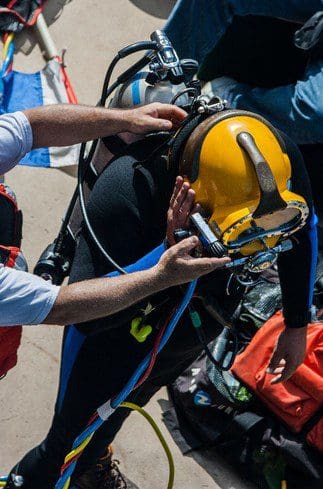
While Campbell River remains the anchor for the business, owners Kelly and Catherine Koral are working on two programs in Panama, one certifying divers to work in open ocean aquaculture and also for certifying divers who work in ships husbandry in the Panama Canal. “We mostly teach here in Campbell River but we have taught courses in St. John’s, Newfoundland, St. George, New Brunswick, and just recently we taught a surface supply diving course to the Masset First Nation band in Haida Gwaii,” said Koral, who started DiveSafe International in 2006, after the commercial diving program at North Island College was cut, along with his instructor position.

“I knew there was a need and a market for local commercial divers so I struck out on my own with DiveSafe and we’ve been going strong ever since,” said Koral, who has trained and graduated over 600 divers.

“Most divers come from other provinces and we have had students from Trinidad, France, Equador, Russia, the United Kingdom and the United States,” he said.

“Last year we trained over 100 divers, making us the commercial dive school with the most graduates in Canada.”Koral said they do not get many local high school graduates signing up for the diving school. He wants to get the word out that there are great, well paying jobs here on the north end of the Island.

Koral considers the job market very good for the people who attend the five-week commercial scuba diving course, describing a situation where students “graduate on Friday and are working on Monday.””Employers are calling us constantly looking for our grads,” said Koral. “These young guys and gals need to know that they don’t have to go to Fort Mac for work, they can stay here and really do well.”Most DiveSafe graduates find work in the growing aquaculture industry. Others work in environmental assessment, scientific diving, engineering inspection, marine construction, the film industry, seafood harvesting and search and recovery. Because of the regulation involved in the industry, Koral described the work as very safe, as well as interesting.

“It’s full of variety. Always changing, different sites, different projects, and always on the go,” he said.

Koral trains divers to the CSA (Canadian Standards) which he said are the highest in the world.”We teach a commercial scuba and inshore surface supply diver course. We are working towards developing an offshore surface supply diver course in the future. Plans for the future are continuous expansion and working towards being Canada’s premier commercial diving school.”In the meantime, students are learning skills they never thought would come in handy. “One of our dive projects is to build a wooden box underwater,” said Koral. “A student had complained bitterly about the project saying ‘never in a million years will I have to build a wooden box underwater’.”

Five years later Koral was working with the same student, now graduated, and working on a hydro dam.

“He was in the water and I was operating the divers radio, when after a few minutes of him having to saw and hammer together a box for a concrete form, he calls up over the radio and said ‘I remember saying in class that in a million years I’d never be building a wooden box underwater and guess what, here I’m building a wooden box underwater’. Well the topside crew had a good laugh.”

For information on how to build a box under water, and other in-demand skills, contact DiveSafe at 250-287-3837 or go to divesafe.com.

[email protected]

Source