Home Blog Page 546

Offshore Rig Takes on Water, Anadarko Halts Ops in GOM

0

Anadarko Petroleum Corp. has suspended operations on an offshore drilling rig Tuesday after being hit by a large storm wave in the Gulf of Mexico at around 3 a.m., John Christiansen, Anadarko’s director of External Communications, told Rigzone. The incident happened about 130 miles from Galveston.

Large waves associated with a recent cold front caused the ENSCO 8506 (UDW semisub) to drift a short distance off location and take on water in a ballast tank inside one of the semisub’s four columns. Rig is stable on even keel, pumps keeping with water ingress, reported USCG Houston. Situated in 3,571 feet of water, the deepwater drilling rig wasn’t engaged in any drilling and didn’t have any oil products on board when a weather front moved through the East Breaks 645 block rocking the facility, according to the U.S. Coast Guard.

Anadarko said 116 crew members are accounted for and uninjured and there have been no evacuations.

USCG planes and Coast Guard Cutter Skipjack are monitoring the situation.

 Source


Divers search for missing passengers of South Korean Ferry

0

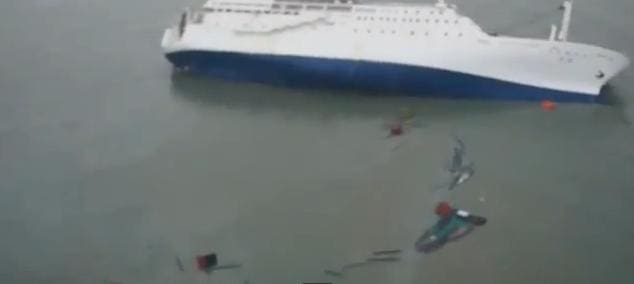
300 passengers are still missing and 6 were confirmed dead South Korean ferry sank off which includes three 17-year-old high school students and member of ferry’s crew.

164 passengers were rescued so far, 55 were being treated for injuries according to the South Korean government minister.

“The ship began tilting all of a sudden, and then people started skidding down from above,” rescued passenger Young-Ja Shin told SBS News. “There was a railing, so I held onto it, but I then got hit by one of the falling people and we got pushed down to the bottom.”

“It took about 10 seconds to tilt over, and then I began sliding from end to end,” rescued passenger Eun-Bok Jang, 50, told SBS News. “I got hit on my side and then I couldn’t breathe.”

The search progress of 160 navy and coast guard divers who were working in the scene were hindered by rapid currents and poor underwater visibility.

There is still no conclusive report what cause the ferry to sink.

Technip, Heerema Awarded $3.5 Bln Subsea Contract by Total

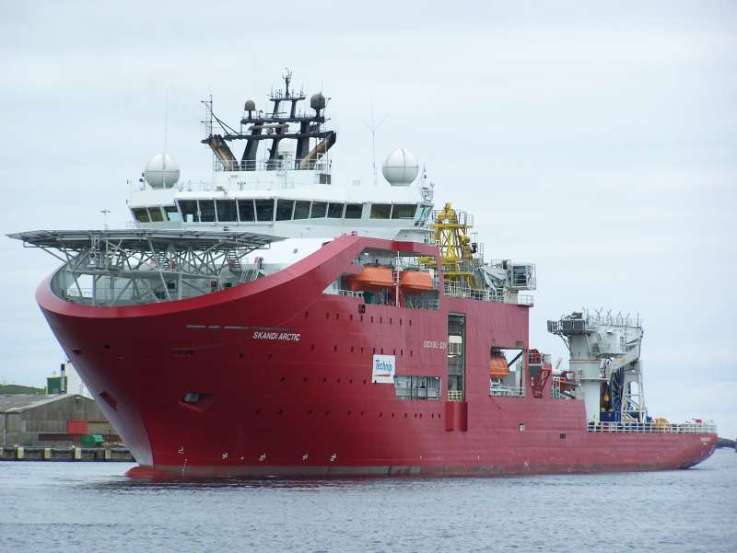
Technip and Heerema Marine Contractors, have signed a major lump-sum contract with Total E&P Angola for the engineering, procurement, construction, installation (EPCI) and pre-commissioning for the SURF (subsea umbilicals, risers and flowlines) part of the Kaombo project, located in Block 32 offshore Angola.

The contract is valued at approximately  $3.5 billion with a Technip share of around 55% and a Heerema share of around 45%.

This project falls within the Technip Heerema strategic alliance formed 15 months ago that offers comprehensive subsea solutions through a unique combination of complementary assets, technologies and capabilities. It provides the industry with a strong and experienced contractor to address the ultra-deepwater market.

The project’s scope of work consists of the engineering, procurement, fabrication, transport and installation of:

– 18 rigid risers, of the Single Top Tension Riser (STTR) type, including large buoyancy tanks (~40m high, ~6m diameter), flexible top riser jumpers and riser base spools,

– approximately 300 kilometers (km) of rigid pipe-in-pipe production and single pipe injection pipelines,

– a large number of subsea structures, piles and steel jumpers.

Besides, it covers the transport and installation of approximately 115km of client-supplied umbilicals, manifolds, well jumpers and flying leads.

The partners will leverage the complementarity of their respective field-proven technologies, thus optimizing the project execution:

– Heerema’s scope will cover the riser systems, as well as the deeper and heavier pipe-in-pipe (18”/12”) production pipelines,

– Technip’s scope will include flowlines, flexible pipe manufacturing and installation, umbilical installation, hook-up and pre-commissioning activities.

The engineering work will start immediately in the Paris (France), Leiden (the Netherlands) and Luanda (Angola) centers with most of the offshore installation activities being scheduled for 2016 and 2017.

National content is of strategic importance to Technip and Heerema and their Angolan subsidiaries will bring their competencies and expertise to the project. Technip Angola Engenharia will provide engineering and project management services, while Angoflex will fabricate pipeline stalks and execute spooling services to the installation vessel. Heerema Porto Amboim will provide fabrication services for the subsea structures as well as double jointing of line pipe sections that later will be installed by the Deep Water Construction vessel Balder.

The flexible pipes will be manufactured at Technip’s FlexiFrance facility in Le Trait (France). The fabrication of the rigid flowlines for reel lay will take place at Angoflex’s spoolbase in Barra do Dande (Angola).

Heerema intends to mobilize its Deep Water Construction vessel, the Balder, to install all STTRs and the pipe-in-pipe (18”/12”) production pipelines. Technip’s vessel, the Deep Blue, will install all the remaining pipelines. Other vessels from Technip’s fleet will install the flexibles and umbilicals and provide construction work support.

The project is scheduled for completion in the first half of 2018.

Thierry Pilenko, Chairman and Chief Executive Officer of Technip, declared: “This project is the largest subsea contract ever awarded to Technip and strengthens our position in the ultra-deepwater market. This award further reflects the confidence of major industry players, such as Total, in the Technip Heerema Alliance to address the significant challenges of ultra-deepwater projects. We are proud to bring an unrivaled complementarity of capabilities, while leveraging leading-edge technologies, R&D and assets. Furthermore, we are delighted to see that this award validates both companies’ commitment to developing facilities and workforce locally for the benefit of the Angolan energy infrastructure.”

Pieter Heerema, Chairman and Owner of Heerema Marine Contractors, declared: “To be awarded the largest SURF project in the industry to date as the first project for the Technip Heerema Alliance is a fantastic success. This award is a recognition that our clients appreciate the value of the Alliance in delivering safe, robust, competitive and unrivalled solutions for large and complex ultra-deepwater projects. Building on our reputations, we are convinced that we will bring this prestigious project to a successful end. Finally, we are very pleased that the award of the Kaombo project allows us to bring substantial work volumes to our Angolan fabrication and marine transportation companies.”

Source

Goliath Installs Jacket Pin Piles at Baltic 2 Offshore Wind Farm

0

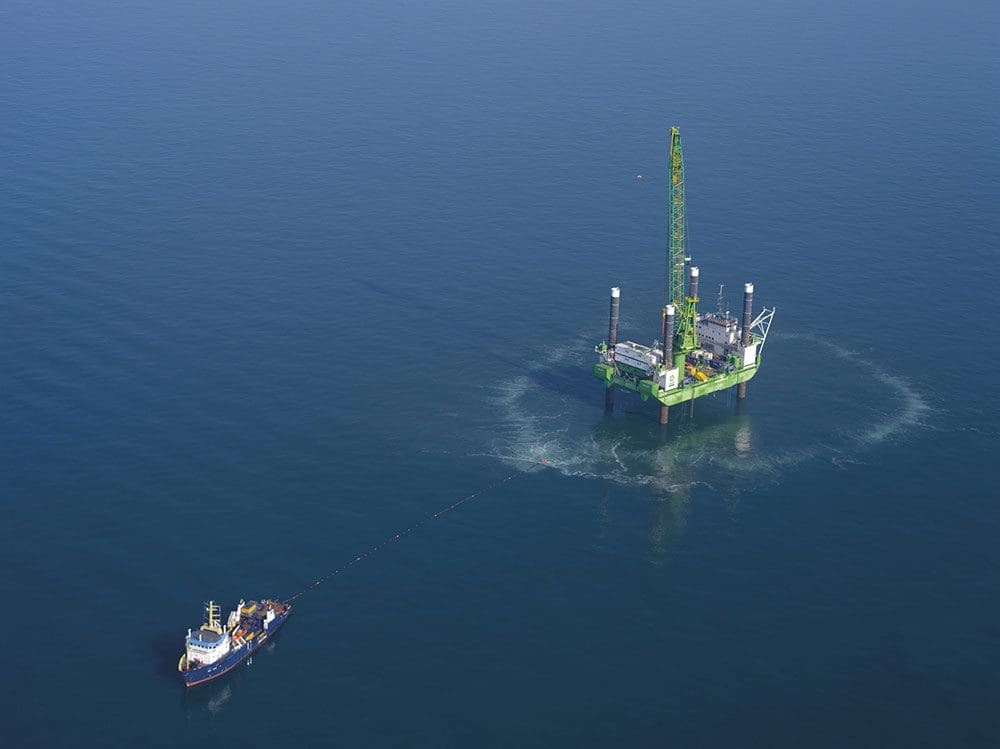
In an email statement the Company confirmed that the installation has been completed on the wind farm located about 32 km north of Ruegen Island in the western part of the Baltic Sea.

As reNews reported, the jack-up vessel Goliath completed the work of driving the piles at the location of each of 41 jackets.

The installation of jackets is expected to start in the second or third quarter by the Taklift 4 vessel.

EnBW Baltic 2 will consist of a total of 80 wind turbines of 3.6 MW each, and will have a total capacity of 288 MW.

Source

Image Source: DEME Group

Top 5 Advantages of getting Offshore Oil Rig Job

1. Good pay and benefits

[dropcap][/dropcap]Although this career can be very tough, it is very rewarding. An entry level can earn US $50,000 – US $80,000 per annum and this only involves working 6 months out of the year. Other technical and professional positions can make US $70,000 – US $220,000 per annum. Most companies provides major medical insurance, life insurance, dental insurance, profit sharing and 401 K programs.

2. Very comfortable accommodation 

[dropcap][/dropcap]Although workers stays in the middle of the ocean, most accommodation meets 4 or 5 star hotel standards. The meals and other living expenses are covered while on board.

3. Challenging work

[dropcap][/dropcap]For someone who likes adventure and love challenges in career, offshore/oil rig job may suit your preference. The job demands workers to perform what most average people won’t do.  This career is physical in nature and requires  you be mostly away from home, long and hard hours of work (14/21 day rotation – 14 days and have 21 off), working in all types of weather condition or in some dangerous situations.

4. Career advancement is achievable

[dropcap][/dropcap]There are many career opportunities you can explore as worker which depends on the company you work for and specific skills. Most companies also offer training programs to enhance skills. Entry level worker can have a lucrative career while developing skills and experience on rigs.

To start a career in this industry does not always require a formal education. While some may require high school diploma, this makes it an excellent choice for school leavers or for those who finds difficulty getting jobs after school. Opportunity to get paid high and promotions is achievable in oil rigs industry.

5. Opportunity to travel

[dropcap][/dropcap]Drilling employments have travel opportunity to countries like Saudi Arabia, Nigeria, the United States, Kuwait, United Arab Emirates, Venezuela, Mexico, Russia, Norway, China, Canada and the United Kingdom. Offshore jobs get greater risks which leads to a higher pay.


Aker Solutions Nets $2.3 Bln Subsea Equipment Contract in Angola

Aker Solutions won a contract worth $2.3 billion from Total to provide a subsea production system for the Kaombo Block 32 development in Angola.

Aker Solutions will deliver 20 subsea manifolds and 65 vertical subsea wellsets. The order also includes associated controls as well as work-over and tie-in systems. The first deliveries are scheduled for the second quarter of 2015.

“This is a landmark contract and further strengthens an important relationship with a key partner,” said Øyvind Eriksen, executive chairman of Aker Solutions.“It’s a significant commercial achievement for our subsea business as well as an important strategic development in our expansion in Angola and the broader region.”

Kaombo, one of the world’s largest subsea developments, is located in block 32 about 150 kilometers off the coast of Angola.

Joint Venture
Aker Solutions is committed to developing local content and project execution capabilities in Angola, where it employs about 130 people. The company has set up a joint venture with Prodiaman Oil Services Lda, an Angolan company that will execute local content activities related to this and other future Aker Solutions subsea projects in Angola.

“I am delighted to be part of this significant project with Aker Solutions for Total,” saidProdiaman’s president Pedro Godinho. “I look forward to seeing that this project makes significant contributions to the education system through knowledge transfer and job creation in a high-tech industry, all for the benefit of Angola.”

Source

Shipwreck from 1860 off Atlantic City to become historic site

0

ATLANTIC CITY – In their last desperate moments, with winds howling and waves crashing around them, crew members rushed below decks and frantically pushed blankets and bedding into the leaking hull.

They hoped to keep the steamer Robert J. Walker afloat long enough to make land near Absecon Inlet Light, but were overwhelmed by the rushing waters of the Atlantic in 1860.

More than a century and a half later, the Walker is still pointed toward the lighthouse and the blue wool blankets the crew used are still lying in the bow, in a murky, emerald green world 85 feet down.

They are eerie reminders of the 21 who struggled and died after the vessel collided with the schooner Fanny during a stormy night about 12 miles off Atlantic City.

The shipwreck was identified last year by the National Oceanic and Atmospheric Administration (NOAA), listed this month on the National Register of Historic Places, and will be mapped for the first time this summer, giving recreational divers and history buffs a clearer picture of the site.

The work will be undertaken by the New Jersey Historical Divers Association, Richard Stockton College of New Jersey, Black Laser Learning, the Edward Marsh Library in San Diego, and local recreational scuba divers in partnership with NOAA.

They will gather data, photos, and drawings that will be displayed in coming months at museums and on the Boardwalk in Atlantic City. Waterproof site maps will be produced for divers touring the wreck.

“There was no Coast Guard” to save the crew in 1860, said Steve Nagiewicz, co-leader of the expedition, science teacher at Atlantic City High School, and former executive director of the Explorers Club. “There was no radar and no radio.

“If they didn’t save themselves, they were going to die,” he said. “After all these years, we’re going to tell the story of what happened.”

The deteriorated ship, one of the first iron steamers built for the U.S. government, is scattered across the ocean floor, NOAA officials said. Parts of its metal frame and iron-plated hull are embedded in the silt, along with the anchors, a large steam engine, and hubs of the side-mounted paddle wheels. The bow lies about 100 feet from the rest of the wreck.

In between, divers have found bits and pieces of the 19th century: “Mason’s” ironstone china, a single cannonball, and unusual rectangular brass portholes.

But the wreck is more than a historic site, said James Delgado, director of Maritime Heritage of NOAA’s Office of National Marine Sanctuaries. It’s the final resting place of 20 men, lost when the ship went down on June 21, 1860. Another died the next day from injuries.

“These were real people like you and me who got caught up in something bigger than themselves,” Delgado said. “They were ordinary folks when fate came up and smacked them.

“History, to me, is more than big names and big events,” he said. “It’s about the guys on the Walker, and [the wreck] is their grave site.”

The 358-ton ship, launched in 1847, was used by the U.S. Coast Survey – NOAA’s predecessor – to survey the depths of ports to facilitate maritime commerce.

One of its crew, Peter Conway, was waiting for the Walker to leave Hampton Roads, Va., on June 12, 1860, when he penned a last letter to his “dear Wife” Ellen, who had just delivered their daughter.

“Try and take good care of your self till I get back and then I will try and take care of you by way of giving you a resting spell,” he wrote. “May God send his choicest blessings on you and your dear infant is in the prayer of your affectionate and devoted Husband.”

On June 21, as the Walker steamed toward New York in a gale, the executive officer, Joseph Seawell, spotted the approaching Fanny, carrying 240 tons of coal to Boston.

Though both ships were clearly lighted, they somehow collided at 2:15 a.m., with the Fanny’s bow anchor striking the Walker’s bow with “considerable force,” opening plates and destroying two lifeboats, Delgado wrote in a report on the collision. Some crew members tried to plug the hole and others used axes to chop down the mainmast for use as a floatation device.

Conway was among the dead. Seawell, his wife, and Capt. John McMullen survived along with more than 40 others. They were rescued by another passing schooner, the R.G. Porter, and the Fanny limped into Cape May.

“It’s almost bone-chilling to know I had a relative” on the Walker, said Lise Sulley, 56, of Cranford, Union County, whose great-great-grandfather Timothy O’Connor was lost in the disaster. “I was in my 30s when I first heard about it, and it means something to me today, even though it’s so many generations away.”

The Walker’s location was unknown until the 1970s, when the wreck was discovered by fishermen who didn’t know the identity of the ship. It became a destination for divers and was positively identified by NOAA in August.

That month, Delgado gave a talk on the Walker at the N.J. Shipwreck Museum at the InfoAge Science Center in Wall Township, Monmouth County, and asked Dan Lieb of the N.J. Historical Divers Association whether he’d help map the site.

Lieb, now expedition co-leader and head of the survey, plans to produce a detailed illustration of the site by the end of the summer.

The privately funded work will begin in June with underwater imaging. Vince Capone of Black Laser Learning, and Steve Evert, manager of Stockton’s Marine Science and Environmental Field Station, will use side-scan sonar equipment to map the ocean bottom.

“When the divers do the detailed mapping, they’ll have a base map to work from,” Capone said. “The ship is not an intact vessel sitting on the bottom, but there is a fair amount of it left.

“It’s a fantastic find and a rare opportunity to document the remains,” he said.

Evert will be accompanied by four to six Stockton undergraduate students who will assist in the research. “There is so much history off the New Jersey coast,” he said. “We’re one of the richest coasts for shipwrecks, but few of them have the ‘oh-my-goodness’ factor, like this one.”

In August, divers will descend to the site twice a day for four to five days.

“We’re going out there in the spirit of camaraderie – to put the finishing touches on research that’s been done up until now,” Lieb said. “I’ve been on a lot of mapping and archaeological expeditions.

“Some were before the rebuilding of a bridge or a traffic tunnel under a body of water,” he said. “This is an opportunity to approach this from a more purist angle on a historic site that won’t be destroyed by construction.”

When the tour map is completed, divers will have a better idea of the site. “We ask people not to take things from the wreck,” Delgado said. “Anything that has been taken should be treated, restored, and put in a museum.”

Source
Deepsea Metro 1 Completes Drilling of Sunbird-1 (Kenya)

0

Pancontinental Oil and Gas NL advises that the Sunbird-1 well off the southern Kenyan coast has been completed and the well has intersected a hydrocarbon-bearing zone in the top of the Sunbird Miocene Pinnacle Reef.

Analysis of the zone itself and recovered hydrocarbon samples are continuing. Analysis of the wireline log data and the fluid samples recovered from the limestone reservoir is complex due to the large volume of drilling fluid, seawater and cement lost to highly porous and permeable zones in the Sunbird Reef, including into the hydrocarbon bearing zone.

Both gas and liquid samples have been recovered. In addition to the recovered gas, the nature of the liquid samples and whether or not these contain naturally occurring hydrocarbon liquids (oil or condensate) remains to be determined by further analysis. The top of the Sunbird Miocene Pinnacle Reef was reached at 1,583.7m subsea. The water depth is 723m.

The 43.6m gross hydrocarbon bearing zone is currently assessed to contain a net pay thickness of 27.8m. In this case, net pay is defined as the cumulative thickness of zones having porosity of 10% or greater. Zones with porosity lower than 10% are not included in the net pay assessment.

At this stage, due to its estimated size, the Sunbird discovery itself is considered unlikely to be commercial. Pancontinental has an 18.75 percent interest in the well and block L10A. The Operator of the Block L10A Petroleum Sharing Contract, BG Group, is continuing to assess the results for the L10A consortium and will recommend a follow-up program.

A further statement regarding the discovery will be made once the remaining analyses have been completed. Sunbird-1 has now been “plugged and abandoned” in accordance with the planned drilling program, meaning that the well has been made safe in such a way that it can be left permanently without further intervention. These measures are designed to ensure that there is no danger of leakage of oil or gas within the well or to the sea floor.

Pancontinental’s Chief Executive Officer Barry Rushworth said the implications for regional exploration were very positive. “The drilling operation using the Deepsea Metro 1 drillship has been completed, with the well drilling into a hydrocarbon-bearing carbonate reef reservoir that was highly porous and permeable,” Mr Rushworth said. “We await the results of the continuing analysis of the data acquired from the well.”

“We encountered a thick and effective seal over the top of the Sunbird Reef, which was an initial risk for us, and the regional follow-on implications are truly great. Porosity, permeability and seal for the reservoir were all better than Pancontinental expected.”

“While the high quality of parts of the reservoir, in terms of porosity and permeability, resulted in the loss of quantities of drilling fluids and consequently the analysis of the hydrocarbon column has been made difficult, we expect to have a conclusive result after further analysis.”

“We look forward to receiving the full and final Sunbird results and we believe that we are now in an excellent position to explore for larger volumes of gas and oil over our very extensive portfolio of prospects and leads offshore Kenya.”

Source

3 Types of Diving Helmets

0

Diving helmet have had a long history. It started in the 1820s with the first successful produced helmet was invented by the brothers Charles and John Deane. Improvements have been made and  features have been added to make it more functional for professional divers.

Here are the 3 types of diving helmets

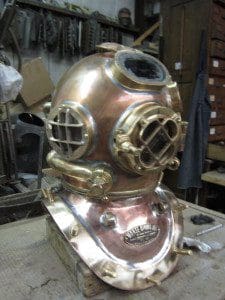
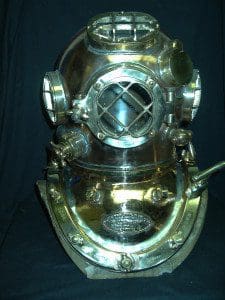
1. Standard Diving Helmet (Copper hat)

Examples: US Navy Mk V helmet, copper Heliox helmets which are made for the US Navy by the Second World War, Mk V Helium

Companies which produces Mark V diving helmets for the US Navy:

  • Morse Diving Equipment Company of Boston, Massachusetts,
  • A Schrader’s Son of Brooklyn, New York,
  • Miller-Dunn Diving Co. of Miami, Florida
  • Diving Equipment and Salvage Co. (later Diving Equipment Supply Co.) of Milwaukee, Wisconsin

morsemorse 2

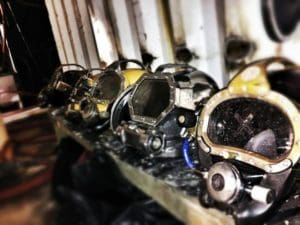
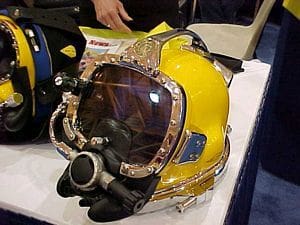
2. Lightweight Demand Helmets

  • Open circuit helmets

Examples:  Gorsky, Kirby Morgan Superlite-17 from 1975, Ratcliffe helmet, often known by its nickname “Rat Hat”

photo credit: Tres Fitzgerald
Photo Credit: Carson Dive Report


Other Notable Manufacturers: Savoie, Miller, and Swindell.

  • Reclaim helmets – use a surface supply system to provide breathing gas to the diver in the same way as in the open circuit helmets, but also have a return system to reclaim and recycle the exhaled gas to save the expensive helium diluent. Which would be discharged to the surrounding water and lost in an open circuit system.

3. Free-Flow Helmets

Examples: Desco “air hat” –  a metal free-flow helmet, designed in 1968 and still in production, Sea Trek surface supplied system, developed in 1998 by Sub Sea Systems, is used for recreational diving. Lama, developed by Yves Le Masson in the 1970s, has been used in television to let viewers see the face and hear the voice of the presenter speaking underwater.


“The Kaombo Project” in Angola – Offshore development decision made by Total

0

Final investment decision have been made by Total and its partners for the offshore Kaombo project in Angola. The expected production capacity is 230,000 barrels/day and the estimated reserves of 650 million barrels.

This project will develop 6 of 12 discoveries made on Block 32, namely among the Gindungo, Gengibre, Canela, Mostarda, Louro, Salsa and Caril fields in water depths of 1,500m.

The unprecedented level of local content of this project requires over 14 million man-hours of contruction works and fabrication which will be handled by locals in Angola yards.