Home Blog Page 250

Oil Crashes 8% As Greek Vote, Iran Talks Set Off Exodus

0

Oil prices suffered their biggest selloff in five months on Monday, falling as much as 8 percent as Greece’s rejection of debt bailout terms and China’s stock market woes set off a deepening spiral of losses.

Adding to the pressure on oil, Iran and global powers were trying to meet a July 7 deadline on a nuclear deal, which could bring more supply to the market if sanctions on Tehran are eased. The self-imposed deadline could be extended again, officials at the negotiations said.

A slump that began last week gathered pace through the session, taking four-day losses to more than 10 percent, the largest rout since early January, as weeks of range-bound trading abruptly ended. Global Brent prices collapsed below the $60 a barrel mark for the first time since mid-April.

“With the number of bearish elements weighing on the market now, the only support has been the seasonal demand in gasoline, and even that will be going away soon,” said John Kilduff, partner at New York energy hedge fund Again Capital.

U.S. crude settled at $52.53 a barrel, down $4.40 or 7.7 percent, from its settlement on Thursday and below the 100-day moving average. It was the biggest percentage drop in a day for U.S. crude since early February, and more downside momentum could push it to test the six-year low of $42.03 set in mid-March, technical analysts said.

Brent settled down $3.78, or 6.3 percent, at $56.54, also below the 100-day average.

Greeks voted a resounding no to a referendum on an international bailout that also put in doubt its membership in the euro. The euro fell against the dollar, weighing on demand for dollar-denominated commodities from holders of the single currency.

Commodities were also sucked into market turmoil that has seen Chinese shares fall as much as 30 percent since June due in part to the economy growing at its slowest pace in a generation.

In Vienna, a dispute over U.N. sanctions on Iran’s ballistic missile programme and a broader arms embargo were among issues holding up a nuclear deal between Tehran and six world powers.

Iran is seeking to restore oil exports that have dropped from 2.5 million barrels per day in 2011 to about 1 million bpd in 2014. Morgan Stanley analysts said up to 700,000 bpd in new Iranian exports were likely to arrive between late 2015 or early 2016, delaying the recovery in oil prices and U.S. output by 6 to 12 months.

Oil prices were also weighed down by signs that U.S. shale drillers were returning to the field, as the rig count for oil rose last week for the first time since December.

It is unclear whether the latest price decline will give drillers pause, though, as many oil producers had been counting on $60 or $65 prices to support new wells.


Source

Farstad Takes Delivery of Far Sentinel

Farstad Shipping ASA has today taken delivery of subsea/construction vessel Far Sentinel (Vard 3 07) from Vard Langsten.

The vessel is designed for subsea construction/IMR operations to 3,000 meters water depth, has an overall length of 142.6 meters, beam of 25 meters and a deck area of 1,800 m².

The vessel is equipped with two offshore cranes, of which the larger one has a lifting capacity of 350 tons, Farstad noted.

Furthermore the vessel is arranged for 3 ROVs (Remote Operating Vehicles) and accommodation for 130 persons.

The long-term financing of the vessel is arranged by Eksportkreditt Norge AS, DNB, Swedbank and GIEK.

There is no charter contract secured upon delivery from the yard, the company added.

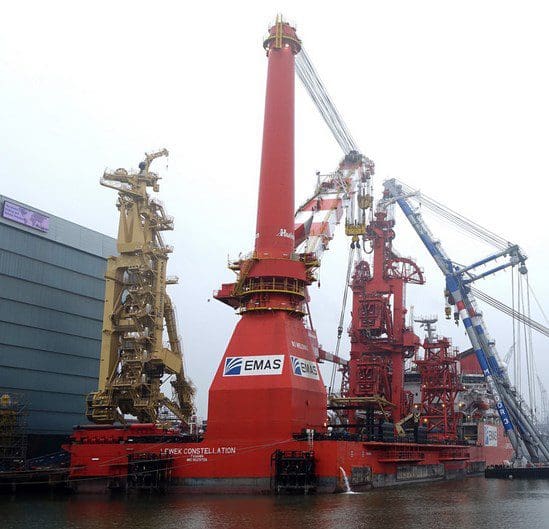
EMAS Bags $24M Charters for OSVs, Post $5.2M Net Profit for 3Q FY2015

EMAS Offshore Limited, an offshore services provider to the oil and gas industry, reported Monday that it has clinched three new charters, valued at more than $24 million including options, for work with oil majors in West Africa and Thailand. The firm secured two contracts from EMAS Energy, a unit of Ezra Holdings Ltd.’s Well Services division.

The first contract is the provision of a Platform Support Vessel to an oil major in Thailand, while the other contract is for the supply of an Anchor Handling Tug Supply (AHTS) vessel for a national oil company, with both deals awarded after a competitive tendering process. Under the $12 million contracts, EMAS Offshore will provide accommodation, towing, anchor handling and logistics support for oil and gas production platforms.

Over in West Africa, EMAS Offshore’s AHTS vessel will provide sea transportation services, including towing, performing anchor handling and positioning of rigs and other floating structures for an oil major. “We have a distinct advantage of being able to deploy vessels globally. I am delighted to see that our strategy of focusing our efforts in West Africa where offshore activities remain healthy is paying off. Additionally, the wins in Thailand demonstrate the synergy we have within the EMAS brand to deliver integrated solutions, and is yet another competitive advantage we can leverage, especially amidst market volatility,” Jon Dunstan, EMAS Offshore’s CEO, said in the press release.

EMAS Offshore indicated that the average duration of the contracts is approximately 1.1 years, with the charters expected to commence in the fourth quarter of financial year 2015 beginning June 1. Meanwhile, the company posted a net profit of $5.2 million in the quarter ended May 31 (3Q FY15), up from the $0.2 million in the corresponding period last year although revenue fell 15 percent to $59.2 million.

The higher net profit was attributed to strong contributions from the Offshore Production Services division — comprising two Floating Production, Storage and Offloading (FPSO) vessels — but this was negated by weaker contributions from the Platform Support Vessel (PSV) and small Anchor Handling, Towing and Supply Vessel (AHTS) business segments. “Amidst the challenging market environment and oil price volatility, we continue to take steps to reduce costs, implement initiatives to improve operational efficiency and increase focus on vessel utilization,” Dunstan said.

Utilization rate in the Offshore Support and Accommodation Services division declined to approximately 70 percent for the quarter amid relatively weak demand for small AHTS and shallow water PSV, which resulted in a utilization rate of 74 percent for the nine months ended May 31. But EMAS Offshore continues to see sustained demand in the larger AHTS segment, where utilization rate remains high at above 90 percent, as vessels of this category are required in the Asia-Pacific and West Africa regions to support various offshore activities.

In the Offshore Production Services division, the two FPSOs, which have high operational uptime of more than 98 percent, are on multi-year contracts and operating in production fields with good long-term production rates and profiles. “Looking ahead, the short-term outlook for the industry still remains challenging, but we believe that our strategy of focusing our capabilities and maintaining operational excellence in key geographical areas will hold us steady,” Dunstan added. 


Source

Royal IHC Launches IHC Concept

0

Royal IHC has brought together a team of experienced industry professionals to form IHC Concept.

Based in Grey Street in the heart of Newcastle-upon-Tyne, it will provide engineering services to the oil, gas, offshore and marine sectors.

Andy Eaton will lead the team, who, using their diverse experience across a wide industrial base, specialise in the design and build of a wide range of Offshore Mission Equipment and Subsea Infrastructure, complimenting offerings from other Royal IHC subsidiaries.

Eaton said: “Taking into consideration the current climate in an uncertain and competitive market, this newly available and adaptable service is already in high demand. IHC Concept is rapidly gaining a client base as well as supporting current IHC projects and new product development.

“We aim to offer the market the ability to react quickly to the widest possible range of challenges and look forward to working within the global network of Royal IHC,” 

Soaring Gas Use Lifts Demand for Regas Infrastructure in Southeast Asia

0

Development of regasification infrastructure is picking up in Southeast Asia, as countries in the region seek to augment declining gas production from their mature hydrocarbon basins by importing liquefied natural gas (LNG) in order to meet both export volumes and increasing domestic requirements.

Southeast Asia is an emerging LNG hotspot, with annual demand growing at 45 million tons, outstripping India’s 20 million tons, according to a Wood Mackenzie’s report released in February 2013.

Malaysia stands as the exception – maintaining its rank among the world’s top LNG net exporters in the foreseeable future. Elsewhere in the region – Indonesia, Thailand and the Philippines – LNG is being sought after to feed domestic demand, and this has, in turn, fueled a drive towards expanding regasification capacity.

THAILAND PROGRESSES LNG TERMINAL, FSRU PROJECTS IN MYANMAR

An official with Thailand’s state-owned PTT Pcl told Rigzone at a recent conference in Singapore that land acquisition is underway on a planned LNG terminal and floating regasification (FSRU) project in Myanmar. The Myanmar FSRU, to be jointly funded by PTT and Thailand’s private power producer Ratchburi Electricity Generating Holding Pcl, is projected to enter operations within the next two years.

Rigzone understands PTT has decided to site the FSRU off Myanmar’s Pilok town instead of another identified location off Thailand’s Dawei district, partly to meet the domestic supply obligation of its upstream unit, PTT Exploration and Production Pcl (PTTEP), to Myanmar. PTT is also eyeing a second FSRU off Thailand’s Channa district in the Songkhla province.

Thailand is in a unique position in that the country derives 90 percent of its domestic sales gas from Myanmar, according to data from PTT. The remaining 10 percent of Thailand’s gas imports – which meet 22 percent of the country’s gas demand – comes from LNG.

Since 2011, PTT has begun importing LNG from the Ma Ta Phut terminal, which is slated to undergo expansion under a second development phase to increase its annual receiving capacity to 10 million tons by 2017.

Indigenous production accounts for 78 percent of domestic sales gas in Thailand, according to PTT. Thailand’s proven reserves are projected to fully deplete in the next six to seven years. With Myanmar imposing domestic gas allocation on PTTEP-operated new phased field developments beyond the producing Zawtika 1A project, PTT has to seek more LNG offtake to secure Thailand’s future gas supplies.

PTT has commissioned WorleyParsons Ltd. for the feasibility studies on the site options for the two FSRUs, each pegged at 3 million tons per year. Each FSRU will take three years to build, outgoing PTT Chief Executive Pailin Chuchottaworn said, as quoted by the National News Bureau of Thailand June 4. The Myanmar regas unit is subject to approval from local authorities.

PHILIPPINES EXPLORES LNG OPTION

Like Thailand, the Philippines is also facing a looming gas crisis as reserves at the Royal Dutch Shell plc-operated Malampaya project – the sole producing gas field supplying domestic users – expected to be fully depleted by 2024. With no visibility on any replacement reserves from a new discovery rivaling that of Malampaya, Philippines National Oil Company’s Vice President for Upstream Raymundo Savella viewed importing LNG as the inevitable outcome to secure supplies of the “greenest” fossil fuel.

The Philippines Department of Energy plans to replace over 15,000 megawatts (MW) of coal-fired electricity supplies with those from gas-fired plants, translating to rising demand for gas over and above the current requirement, Savella suggested.

In Luzon, where 50 percent of Filipinos reside and gas generates about 40 percent of power requirement, Shell has been reviewing potential sites for its first regas facility.  One informed source said Chevron Corp. had also embarked on feasibility studies on a regas unit in Luzon, although this could not be confirmed with the supermajor.  Savella believes the sprawling archipelago is ideally suited for small to mid-scale LNG developments.

INDONESIA NEEDS MORE FACILITIES TO BOOST LNG IMPORTS

Southeast Asia’s other giant archipelago nation, Indonesia, looks set to take the lead in small to mid-scale LNG and regas developments in the region as its president, Joko “Jokowi” Widodo embarked on his pledged 35,000 MW electrification plan during his first five-year term.

For Jokowi to deliver on his pledged electrification plan, Indonesia would require more LNG imports to fill a widening shortfall of domestic gas supplies exacerbated by delays in upstream gas field developments. Large-scale field developments including Chevron-operated Gendalo-Gehem gas and condensate development and Inpex Corp.’s Abadi floating LNG project had been held back by among others, a lack of clarity in the extensions of the existing production sharing contracts.

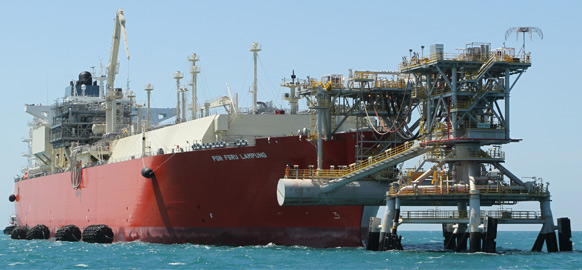
PGN’s Lampung FSRU
PGN’s Lampung FSRU, Source: PGN

Within the last three years, Indonesia has already brought two FSRUs onstream – the Nusantara Regas and the Lampung FSRU. Plans have been mapped out for at least two further leased FSRUs off Medan and Cilacap, although as an Indonesian LNG veteran Theo Lekatompessy pointed out, investment approval on any further FSRUs could not be expected until late 2015, at the earliest. The Indonesian cabinet also looks set to be undergoing a reshuffling, with two key positions influencing the energy sector under review, sources said.

Indonesia’s LNG regas and shipping market, however, is buoyed by two major tenders stemming from state utility, PT PLN (Pesero), which calls for the supply of gas and import infrastructure plus the construction of small scale power plants across 32 locations in Java, Sulawesi and West Kalimantan.

Theo Lekatompessy
Theo Lekatompessy, Source: PT Humpus Intermoda Transportasi
Source: PT Humpus Intermoda Transportasi

Theo, who heads up Indonesia’s pioneer LNG shipping outfit, PT Humpus Intermoda Transportasi, believes demand for the cleaner burning fuel alternative to coal could be much improved if the government were to extend subsidies for the use of gas in the industrial sector. Industrial users will be resistant towards forking out the initial investment to convert the coal-fired power plants – for instance at a large majority of smelters across Indonesia – into gas-fired units, Theo said.

Small-scale regas and power plant developments are nonetheless on track to take off not only in Indonesia, but also in the Philippines.

The floating regas segment is dominated by several key players, Hoegh LNG Partners LP, Golar LNG Ltd. and Excelerate Energy L.P., building businesses out of operating leased units. Other industry players including Australian engineering giant WorleyParsons are also weighing opportunities in the emerging regas and power plant business. 

WorleyParsons’ Senior Vice President of Global LNG and FLNG Paul Sullivan said discussions are underway with a potential partner on the joint development of a generic LNG storage and power solution that can be “applied anywhere in the world”.


Source

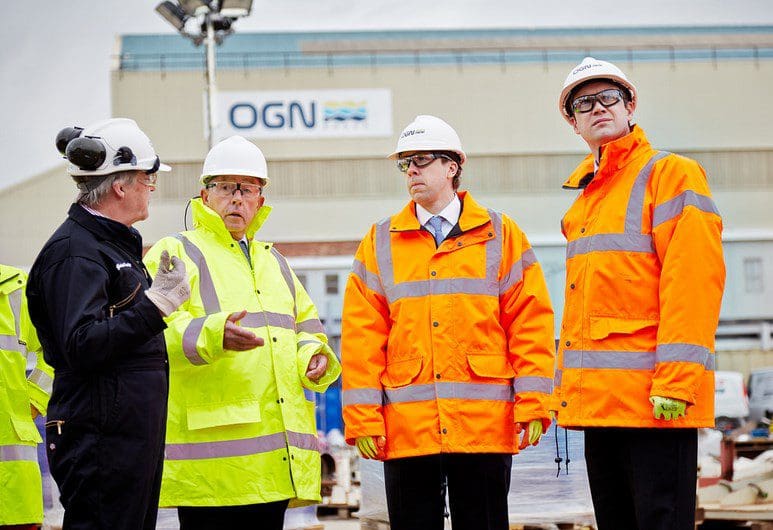
OGN Establishes New Pipework Division

0

OGN Group has launched a new pipework division to deliver specialist fabrication services for bespoke projects.

Utilising its purpose-built facilities at the 32-hectare Hadrian Yard on the banks of the River Tyne in Wallsend, OGN provides a range of services for all forms of fabricated pipework to oil and gas, petrochemical and subsea codes.

The division, which is manned by a team of experienced engineers, also offers onsite Radiography Inspection, Positive Material Identification, Pipework Blasting & Coating Activities in addition to Pneumatic & Hydrostatic Pressure Testing, the company wrote.

The capabilities of the division are supported by a recent investment by OGN in an automated cutting machine, which delivers a Computer Numeric Control (CNC) capacity that previously could only be produced by manual cutting.

The technology offers flexibility and increased range of use through two cutting methods. It is capable of processing pipe from 50mm OD up to 1200mm OD, with plasma cutting on pipe wall thickness of up to 20-25mm and Oxy-Gas on pipe walls above 25mm thickness.

David Edwards, CEO of OGN Group, said: “The skills of our workforce and the investments we have made in our facility and technology has enabled us to create this division, which will operate alongside larger EPC projects we deliver.

“As the offshore market is evolving we are experiencing interest from both existing and potential customers throughout the energy sector looking at our capabilities to provide bespoke fabrication work that is part of other projects.

“Our focus on productivity, which is supported by the investments we have made in new technology, is attractive to operators and other contractors who are addressing the well-publicised challenges facing the industry, and in particular the UK oil & gas market.

“The launch of the pipework fabrication division is part of our approach to remain an agile and proactive part of the supply chain through its current evolutionary journey, as we ensure to meet all of our clients pipework fabrication requirements.”

New Approach to Reduce Wave and Tidal Project Risks

0

The Offshore Renewable Energy (ORE) Catapult and Frazer-Nash Consultancy have produced a standardised approach to assessing and reducing uncertainty associated with energy yield assessment for wave and tidal energy projects.

This approach will ultimately help to reduce risk and make projects more attractive to investors.

Until now, there has been no standardised methodology or common terminology for energy yield and uncertainty assessments. The outputs from this project are a major step forward in addressing these issues and will bring substantial industry benefits, including:

  • Increased understanding amongst project developers of the uncertainties (and therefore risks) associated with projects to help them prioritise uncertainty-reducing activities;
  • Helping project financiers to understand the importance and potential scale of uncertainties and inform discussions on financial risk;
  • Enabling researchers to prioritise research activities to help reduce these risks.

Ralph Torr, Renewable Technology Engineer for ORE Catapult, said: “The perceived level of risk associated with wave and tidal energy projects is high. Being able to more accurately determine the energy output of a potential wave or tidal energy project is a key part of reducing this risk and is central to optimised project design and reducing the costs of financing. This project provides a common language and a standardised approach to assessing and reducing uncertainty.”

Neil Adams, Group Leader at Frazer-Nash, said: “We’ve worked extensively with the ORE Catapult, industry and academia on this programme.”

“We have developed a structured guidance document and intuitive tool to determine the uncertainty on energy yield simply and systematically. It helps identify key uncertainties and allows projects to be compared on a like-for-like basis. This will assist project developers and financiers decide where to invest their capital.”

Technip Plans 6,000 Layoffs as Part of Restructuring Efforts

0

Paris-based engineering company Technip S.A. is the latest oil and gas company to announce layoffs as a way to combat a “challenging environment in oil and gas.” As part of its restructuring plan, Technip will lay off 6,000 of its 38,000 employees from its global workforce. The cuts will be implemented over the next 18 months, a Technip spokesperson told Rigzone.

The layoffs come as part of the company’s decision to “accelerate its cost reduction and efficiency efforts worldwide,” according to a statement released by the company. The restructuring plan is expected to save the company over $918 million – almost $775 million will be delivered in 2016 and the remainder in 2017. 

A significant part of the restructuring plan addresses the onshore/offshore segment’s “unsatisfactory performance,” including reducing the company’s presence in some onshore/offshore markets where profitable business is unlikely. This is expected to take place in Europe, Asia and Brazil. The company will reinforce investment in key geographic and technological areas, such as FLNG (floating liquefied natural gas). In the subsea sector, Technip will further reduce its fleet, with plans to reduce two more vessels in addition to the two vessel reductions previously planned. This will bring the total number of vessels to 23.

Technip chairman and CEO Thierry Pilenko said in a release that “the slowdown in the oil and gas industry is prolonged and harsh” and that the restructuring “will have tough consequences for employees across the Group.”

Technip joins a host of other companies who have implemented workforce reductions (a total of more than 150,000 jobs lost globally) and restructuring plans as a means of dealing with the volatility of global oil prices.


Source

Plexus Strengthens Position in China

0

Plexus has entered into a collaboration agreement with China Oilfield Services Limited (COSL), Red Sea Technologies (RST), and Plexus’ Chinese licensing partner Yantai Jereh Oilfield Services Group (Jereh).

The collaboration agreement will explore commercial opportunities for shallow water subsea and crossover wellhead production systems for oil and gas field activities in China.

Plexus and Jereh will combine the POS-GRIP method of engineering known for its safety, performance and reliability capabilities and Jereh’s first class manufacturing and sales and marketing skills, to work alongside COSL and RST to collaborate on the design, development, manufacture, supply, installation and provision of aftermarket services for the significant Chinese shallow subsea systems and crossover wellhead production systems market.

Plexus’ CEO, Ben Van Bilderbeek, said: “We are delighted to have signed this significant collaboration agreement with COSL, RST and our new Chinese licensing partner Jereh, which will see us strengthen our reach in the Chinese oil and gas wellhead services market where we see exponential growth potential over the coming years. Demonstrating our commitment to building our presence in the exciting Chinese market, we are equally delighted to have announced the signing of our licence agreement with Jereh who are also part of this collaboration agreement.

“In addition to actively building on our existing position in the Asian region following the establishment of our Malaysian and Singaporean hubs and our major licence agreement with Jereh, we are pleased to continue to build upon our reputation of delivering a new standard of wellhead products with key global strategic partners. This latest collaboration agreement is another significant milestone in this journey, and Jereh and Plexus look forward to designing and manufacturing a range of innovative shallow water oil and gas equipment solutions for the Chinese market where COSL has the largest fleet of offshore oilfield services facilities in China. Whilst we predominantly supply into the jack-up exploration arena we remain committed to POS-GRIP product innovation and as such are focused on making significant inroads into the volume production and subsea markets. We look forward to working with COSL, RST and Jereh on this newly formed collaboration relationship and further look forward to updating shareholders on our progress.”

Repsol Starts Production at Giant Perla Field Offshore Venezuela

0

Spanish major Repsol S.A. announced Monday that it has begun production at its giant Perla gas field in the Gulf of Venezuela.

Holding an estimated 17 trillion cubic feet of gas in place, Perla is the largest gas discovery in Repsol’s history. The company expects it to produce 150 million cubic feet of gas per day initially, rising to 450 million cubic feet per day by the end of 2015. This gas is intended to be used for local consumption in Venezuela.

During the following two phases of development, Perla’s output will increase to 1.2 billion cubic feet per day by 2020 – a volume that is expected to be maintained until 2036.

Perla was discovered in 2009 by Repsol and Eni, the operators of the Cardón IV block, in shallow waters in the Gulf of Venezuela, 30 miles offshore.

Repsol said that the start-up of Perla is the eight key growth project to be completed in its 2012-to-2016 strategic plan.


Source