Home Blog Page 195

Military Diving

0

According to legend, military combat swimming originated around 480 B.C. in a retaliatory operation against King Xerxes of Persia. Originally employed as salvage divers, Scyllias and his daughter, Cyana (or Hydna), found themselves hostage to Xerxes, who wished to retain their services during his wars against the Greeks. On a stormy night, the pair escaped by diving into the sea and breathing through hollow reeds. During their dive, they cut the mooring lines of Xerxes’ fleet, causing many of his ships to collide and be damaged or sunk in the stormy waters.

A century and a half later, during the siege of Tyre in 332 B.C., Alexander the Great’s military divers used an early prototype of a diving bell to help them remove obstructions from the water. The diving bells Alexander commissioned featured glass that allowed his combat swimmers to examine the seafloor. It is even rumored that Alexander himself used the diving bell to survey his men’s work.

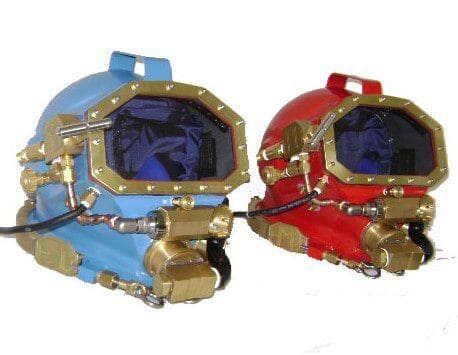
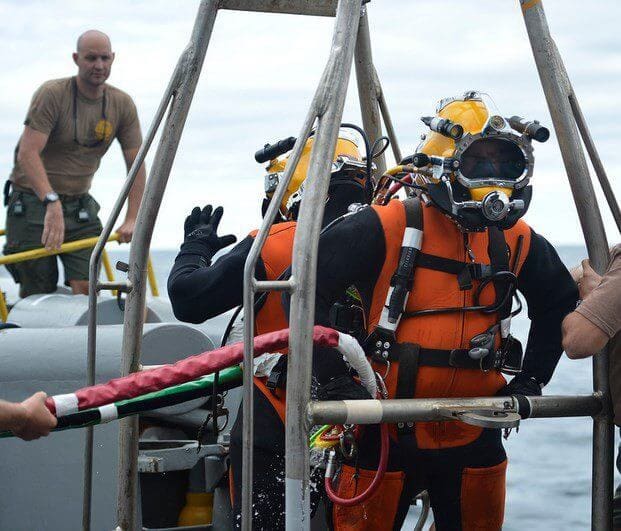
With increasingly sophisticated equipment, modern military divers are essential to many missions and campaigns. In addition to combat and demolition missions, military divers perform underwater reconnaissance, ordnance disposal, construction, ship maintenance, search and rescue, salvage operations, saturation diving and underwater engineering. Every branch of the U.S. military employs divers, and more than 40 nations have military diving operations today.

Military diving is an elite classification that entails risks and responsibilities unlike those of any other type of advanced diving. The contributions of military diving to both professional and recreational diving go far beyond the dive tables taught to new divers. In fact, development and innovation in military diving equipment often translates to recreational and technical diving practice.

Salvage Diving

The origins of modern military diving coincide with the spread of submarine technology in the early 20th century. Accidents and collisions marred the first several decades following the widespread deployment of submarines, so military diving’s focus at that time was on salvage.

In March 1915 the submarine USS F-4 sank in 300 feet of water during maneuvers off the coast of Honolulu, killing 21 sailors. During the mission to salvage the F-4Chief Gunner George Stillson employed staged decompression, which allowed divers to examine the wreckage and work toward raising the boat. Further difficulties salvaging the vessel led Lt. Cmdr. Julius Furer to suggest the use of submersible lifting pontoons for the first time in any salvage mission.

One of the most intensive U.S. salvage operations began after the 1941 attack on Pearl Harbor. For two years following the attack, salvage divers worked diligently, logging nearly 20,000 hours underwater. Their labor and expertise allowed the military to place several battleships and numerous destroyers and supply ships back in service.

Alongside many of these salvage operations were rescue and recovery missions, which motivated the development of new diving equipment and provided opportunities to test them. As a response to the loss of the USS S-51 and the USSS-4 in the 1920s, for example, Charles B. Momsen and Allan Rockwell McCann developed the McCann-Erickson Rescue Chamber in 1930. Less than a decade later, the device assisted in the rescue of 33 submariners from the USS Squalus.

Momsen also designed his famed escape lung around the same time. The escape lung was a rudimentary rebreather consisting of a rubber bag and a canister of soda lime (to remove carbon dioxide). In October 1944, 13 submariners used the escape lung after a torpedo struck the USS Tang. Several men made it to the surface using the device, but others died in the attempt, perhaps because of lack of training in its use. Momsen’s technology contributed to the development of the Steinke hood and to the subsequent development by the British Navy of the Submarine Escape Immersion Equipment (SEIE), which is currently used by most NATO naval services.

Salvage diving in the modern world is a continually advancing discipline, following the modification and improvement of many devices for remotely operated deepwater situations. The military’s role in the advent of deepwater technologies is essential to the field’s growth.

Combat Diving

Combat diving requires specialized equipment and exposure to environmental elements absent from other military exercises. As an advanced diving technique, combat diving depends chiefly on closed-circuit breathing equipment, high-speed/low-profile vessels and finely tuned teamwork. Operating in hostile environments also requires expertise beyond what is standard in even the most highly trained elite combat branches.

In the United States, military experiments in combat diving go back as far as the Revolutionary War. After experiments with fellow Yale student Phineas Pratt to develop a timed detonator that would allow bombs to explode underwater, David Bushnell designed a miniature proto-submarine, the American Turtle, to allow its one-man crew to affix timed bombs to ship hulls. Unfortunately, the Turtle‘s drill was unable to penetrate the copper sheeting on the hulls of the British ships and failed to sink an enemy vessel. Other contemporary innovations included using water as ballast for submerging and raising submarines, employing breathing devices and attaching mines to the hulls of target ships.

During World War II, the Italian Navy solidified the importance of underwater attacks in modern warfare. The relative weakness of the Italian military in surface operations drove them to assemble a force of naval commandos who used closed-circuit oxygen systems to ride underwater on torpedoes modified for transportation. Using this method, Italy’s commando units successfully attacked two British battleships in Alexandria Harbor in 1941 and did significant damage at Gibraltar in 1942 and 1943.

The United States also saw significant advances in combat-diving technology during World War II. At that time Dr. Christian Lambertsen, now considered the “father of military combat diving,”1 was a medical student in the process of inventing the United States’ first closed-circuit oxygen rebreather system, the Lambertsen Amphibious Respiratory Unit (LARU). Although closed-circuit systems already were in use by European military powers, Lambertsen’s system featured a more efficient design. Lambertsen’s professor at the University of Pennsylvania, a former British Army officer named Henry Bazett, saw the LARU’s potential for military application and in 1941 alerted the U.S. Navy’s Experimental Diving Unit and the British Admiralty, reporting that the “apparatus has advantages in lightness and freedom of movement in the water, making it adaptable either for use of underwater troops of the trouble-making type or for night-raiding enemy defenses.”2 The importance of this invention cannot be overstated, as it allowed divers to traverse long distances in stealth mode without releasing bubbles into the water.

During World War II Lambertsen contributed not only in equipment development but also as a military combat diver. In addition to training combat swimmers using an early version of the swimmer delivery vehicle (SDV), he was a true warrior, participating in missions to destroy and cripple enemy vessels. His work with the Office of Strategic Services (the forerunner to the Central Intelligence Agency) and with Special Operations Command during and after the war provided a practical and scientific foundation for the use of rebreathers in military operations today.

After the war many of the combat swimmer teams were disbanded, but Cmdr. Francis Douglas “Red Dog” Fane secured the ongoing relevance of the U.S. Navy’s Underwater Demolition Teams (UDTs). In 1948 Fane invited Lambertsen to the Naval Amphibious Base, Little Creek, near Norfolk, Va., to train his two UDT squads in LARU equipment. In these early days many Navy commanders saw no use for the teams, but Fane recognized the military value of maintaining this combat element.

Fane played an enormous role in the introduction and improvement of many popular pieces of diving equipment. For example, he endorsed use of Jacques Cousteau’s Aqua-Lung and began training UDT squads at Little Creek on the open-circuit system in 1949. Later that year, Fane’s team used the Aqua-Lung to place explosives on a sunken wreck that was blocking the Norfolk shipping channel. Following that success, the Aqua-Lung saw combat use during the Korean War. Fane also acted as an early adopter of neoprene exposure suits, and his divers set the stage for widespread wetsuit use.

Interestingly, Fane also inspired the character of Mike Nelson in the popular television series Sea Hunt, which began its four-year run in 1958, inspiring children of the era to make dives into their swimming pools and bathtubs and dream of adventures in the sea. The show is largely responsible for turning “scuba” and “Aqua-Lung” into household words.

Today, the Navy SEALs are the world’s most recognized combat divers. Their legacy begins with the Office of Strategic Services during World War II and traces through the Korean War’s UDTs into the present day. In 1961 the Unconventional Activities Committee established SEAL units in the Pacific and Atlantic and recommend the acronym SEAL as a combination of “sea, air and land” to indicate “all-around, universal capability.”3 The establishment of two SEAL teams in early 1962 recognized the need to combine sea, air and land expertise for the purposes of conducting unconventional, counter-guerrilla and clandestine operations.

Through Lambertsen’s early influence and leadership, all branches of the military have been involved in combat diving. This year the U.S. Army Special Forces Underwater Operations School on Fleming Key near Key West, Fla., celebrated 50 years of dive combat training.

Fleet and Engineering Diving

In addition to combat and salvage diving, military diving requires tasks such as inspection, repair, underwater electronics installation, construction, torpedo recovery and harbor clearance. Recently, the U.S. Army Corps of Engineers instated a dive team, which completed its first underwater missions in 2012. This team, called the Forward Response Dive and Survey Team, employs bottom SONAR surveys augmented by surface and underwater inspection of sea-bottom, seawall, pier and docking facilities. They couple the information gathered through structural surveys with diver observations to facilitate major repairs and harbor dredging. There are currently 15 Army installations with waterfront facilities that require inspection every four years.

From Navy dive tables to technological and technical innovations, military operations have contributed many significant scientific, medical and equipment advancements that have permeated commercial and recreational diving.



Source

LIGHTPATH, A Road To Improving Safety

Limited to zero visibility is one of the hurdles that divers face underwater when doing their jobs. Countless incidents in the diving industry are caused by poor lighting.

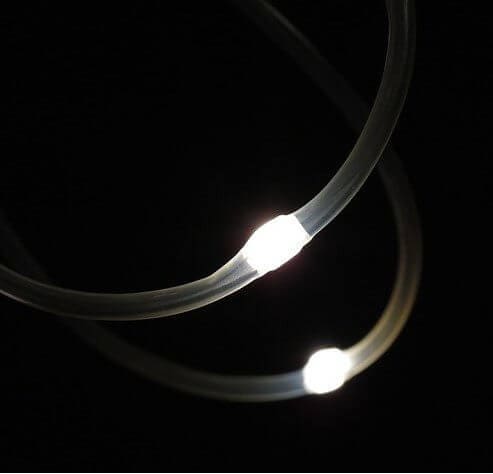
PhotoSynergy Ltd has come up with a solution that can significantly improve safety for commercial divers especially those that works at great depth like saturation divers. The company has developed LIGHTPATH which provides lighting to saturation divers through the umbilical cable. The LED (light emitting diode) wraps around the diver’s umbilical in a spiral manner and can extend up to 100 meters.

LIGHTPATH also known as SLS2000 is a compact light source that illuminates up to 150 meters deep. There is no electrical power in the LED illuminator because the control box can be situated remotely such as on the surface, ROV or diving bell. It only requires approximately 7 watts for it to work making it extremely cost effective.

The idea is to be able to see the route of the divers’ umbilical which can significantly reduce underwater accidents.

“We had been testing the SLS5000 with a number of clients during its development phase and had received feedback from divers and their teams on the benefits of having a low power, minimal sized package, which would not impede the diver and which could be illuminated from the diver end as opposed to the dive bell end.

The first unit was ready for testing just two months after we received the initial feedback on specific requirements. As a sealed-for-life unit, it’s a first for PSL and simplifies the construction in terms of its complexity, part count and minimal size, and maintenance while retaining the lighting concept. It’s our aim to start sea trials by the end of this year at the very latest”, stated Don Walker PSL’s director.

LIGHTPATH has been tested in The Underwater Centre, Fort William.

Oil Search Rejects Woodside’s $8B Takeover Bid as Too Low

0

Oil Search Ltd. rejected Woodside Petroleum Ltd.’s $8 billion takeover bid, saying the proposal undervalues the company’s liquefied natural gas expansion plans in Papua New Guinea.

“The feedback we got from all the major shareholders we consulted with confirmed that the proposal was one that should be rejected,” Oil Search Chairman Rick Lee said on a conference call Monday. “The proposal on whatever basis you apply was significantly undervaluing Oil Search and certainly not one that encouraged us to consider it further.”

Woodside’s bid of one share for every four Oil Search shares, which implied a 14 percent premium, was too low to win investors’ support, according to Sanford C. Bernstein & Co. and UBS Group AG. The offer last week valued Oil Search at A$11.65 billion ($8.1 billion) and would have been the biggest energy takeover in Asia. Oil Search fell as much as 3.1 percent to A$7.22 as of 10:21 a.m. Sydney time, while Woodside slid 1.2 percent to A$28.08.

Woodside Chief Executive Officer Peter Coleman is seeking a stake in Papua New Guinea’s LNG industry and has said he’s aiming to create a regional “oil and gas champion.” Papua New Guinea’s LNG projects are seen as lower cost than developments elsewhere in the world and economically viable even after a drop in oil prices of about 50 percent in the past year.

“If any proposals are tabled in the future that reflect compelling value for Oil Search shareholders, we will engage on them,” Oil Search said in a statement on Monday.

Woodside said in a separate statement that its proposal provided a “material premium” to Oil Search’s share price before speculation of a potential approach emerged. A meeting between the two companies, scheduled for Sunday, was called off at Oil Search’s request, according to an earlier announcement from Woodside.

POTENTIAL COUNTER-BIDDER

“Woodside is surprised and disappointed that the board of Oil Search has rejected the proposal without meeting with Woodside to understand the benefits of the opportunity or to negotiate the terms of a possible merger,” according to the Perth-based company’s statement.

Woodside, which offered the equivalent of A$7.65 a share, would likely need to offer at least A$8.50, and possibly as much as A$9, UBS estimated in a report last week.

Exxon Mobil Corp. is the most-logical potential counter- bidder, according to a Deutsche Bank AG report last week. Other possible suitors include Total SA, Japan’s Inpex Corp. or Malaysia’s Petroliam Nasional Bhd, the report said.

Oil Search owns 29 percent of Exxon’s PNG LNG project and is seeking to expand in the Pacific country near Australia. The partners in the $19 billion Exxon project are considering adding capacity, while Oil Search is also in a venture with Paris-based Total and InterOil Corp. that’s planning the country’s second gas export development.

Oil Search said Monday that it is in a good position to fund the development of its growth projects and to capitalize on a recovery in oil prices. It said it has liquidity of $1.6 billion, including $850 million in cash.

Any successful proposal would require approval of the PNG government, which holds a 9.8 percent stake in Oil Search. Abu Dhabi-owned International Petroleum Investment Co. owns a 13 percent stake.


Source

Global Marine Delivers Nigeria-Cameroon Subsea Link

0

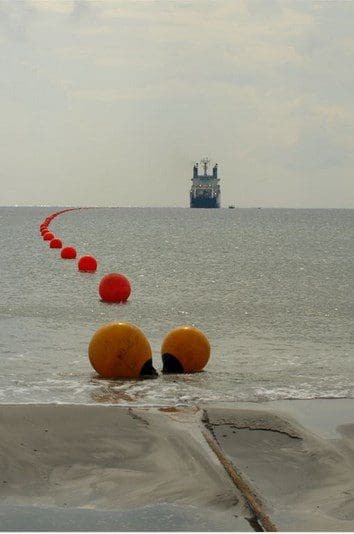
Global Marine Systems, a UK-headquartered specialist in underwater cabling and engineering projects, has just completed a fibre optic installation project in the Gulf of Guinea.

This telecommunications project for Huawei Marine Networks (HMN), a Global Marine joint venture partner, will be the first installation of the R2 repeater following successful sea trials, which took place on Cable Innovator in November 2014.

The project, saw the installation of a 1,011 km repeatered fibre optic subsea cable system installed between Lagos in Nigeria and Kribi in Cameroon. It also encompassed a branching unit, for future connection, to Escravos and Qua Iboe in Nigeria’s southeast region.

Project activities included PLGR (post lay grapnel run) and route clearance, surface lay, cable burial, the supply and installation of pipeline crossing protection, PLIB (post lay inspection burial), and direct shore ends. Global Marine’s C.S. Sovereign, a multi-role DPS-2 vessel, undertook the project. Earlier this year, C.S. Sovereign successfully completed a platform-to-platform fibre optic system installation in the North Sea for oil & gas communications specialist Tampnet, complete with a Cable End Module (CEM) deployment.

A highlight of the project was the first deployment of HMN’s RPT 1660 R2 repeater. Which, provides an optical loop back facility for performance monitoring and accurate fault location.

“We are very proud to successfully deliver this system for HMN,” says Andy Lloyd, Director, Installation at Global Marine. “Coupling our expertise and our long standing capability in subsea engineering with HMN’s advanced transmission technology, we are confident that this system will bring solid, high capacity data communications to Nigeria and Cameroon.”

Brazil’s Stocks Fall Amid Bets Petrobras Turnaround Will Fizzle

0

Petroleo Brasileiro SA’s tumble to a 12-year low put the Ibovespa on pace for a second week of losses. The state-controlled oil producer extended a three-day slide to 11 percent after Standard & Poor’s cut its credit rating to junk, adding to speculation the company will struggle to shore up its balance sheet. The downgrade should raise debt costs and reduce potential valuations on possible asset sales, according to Bank of America Corp.

Petrobras, as the company is known, also followed a slump in crude after Goldman Sachs Group Inc. predicted a global supply glut could send the commodity to $20 a barrel. Petrobras’s Chief Executive Officer Aldemir Bendine is seeking to contain damage from a decade of alleged kickbacks with plans to sell $15.1 billion in assets by the end of next year.

The world’s most-indebted oil company is joining producers from Chevron Corp. to ENI SpA in trying to raise cash and cut operating costs amid a rout in oil. “Petrobras downgrade made the situation even worse, hindering the outlook for the company’s recovery plan,” Paulo Henrique Amantea, an analyst at brokerage H.H. Picchioni, said from Belo Horizonte. 

“That adds up to the already very bad scenario for Brazilian stocks.” The Ibovespa fell 0.2 percent to 46,420.41 at 11:55 a.m. in Sao Paulo, extending its weekly decline. Petrobras’s $2.5 billion in bonds due 2024 declined to the lowest level since they were first issued in March 2014. The real dropped 1 percent to 3.8870 per dollar. 


Source

GE, Pemex Ink Cooperation Deal

0

GE and Mexico’s Pemex have signed a memorandum of understanding (MOU), as part of the GE’s quarterly meeting of its corporate executive council in Crotonville, New York, with the presence of Pemex CEO, Emilio Lozoya Austin and GE’s chairman and CEO, Jeff Immelt.

As an answer to the new situation in the Mexican market, Pemex is in a process of transformation and has redesigned its business strategy with the purpose of finding partners that would strength its operational capabilities, share the risk of execution and generate new businesses .

In this sense, the MOU sets the framework for GE and Pemex to work together on technological and financial solutions for gas compression, power generation and hydrocarbons production, onshore and offshore, including subsea and downstream.

Furthermore, GE will explore opportunities for the local expansion of its manufacturing and engineering capabilities, and will foster the implementation of technologies based on the Industrial internet –the internet of things. Finally, both companies will share best practices on training and human resources.

Baker Hughes: US Oil Drillers Cut Rigs With Crude Price Decline

0

U.S. energy firms cut oil rigs for a second week in a row, data showed on Friday, a sign the latest price declines may be causing some drillers to put on hold their recently announced plans to return to the well pad. Drillers removed 10 rigs in the week ended Sept. 11 and 13 rigs in the week ended Sept. 4, bringing the total rig count down to 652, after adding rigs in six of the past eight weeks, oil services company Baker Hughes Inc said in its closely followed report.

That was the biggest two-week decline since early May. Those additions since the start of July showed some drillers had followed through on plans to add rigs announced in May and June when U.S. crude futures averaged $60 a barrel.

U.S. oil prices this week, however, averaged $45 a barrel, down from an average of $47 last week. Earlier Friday, U.S. crude prices were down more than 2 percent after two banks, Goldman Sachs and Commerzbank, both slashed their crude forecasts, citing lingering oversupply concerns and worries over China’s economy. “The oil market is even more oversupplied than we had expected and we forecast this surplus to persist in 2016,” Goldman said in a note entitled “Lower for even longer.”

Drillers this week cut one oil rig in each of the four major U.S. shale oil basins: the Eagle Ford in South Texas, Niobrara in Colorado and Wyoming, Bakken in North Dakota and Montana, and Permian in West Texas and eastern New Mexico. In response to falling prices, U.S. oil production has declined over the past several weeks with current output down to about 9.1 million barrels per day last week from an average 9.6 million bpd from late May to mid July, the highest since the early 1970s, according to government data.

Those output reductions occurred months after U.S. energy firms slashed spending, cut thousands of jobs and idled around 60 percent of the record high 1,609 oil rigs that were active in October as prices collapsed from around $107 a barrel in June 2014 to under $44 in January on lackluster global demand and lingering oversupply concerns. 


Source

Hexatronic Nets Subsea Cable Order from A-2-Sea

0

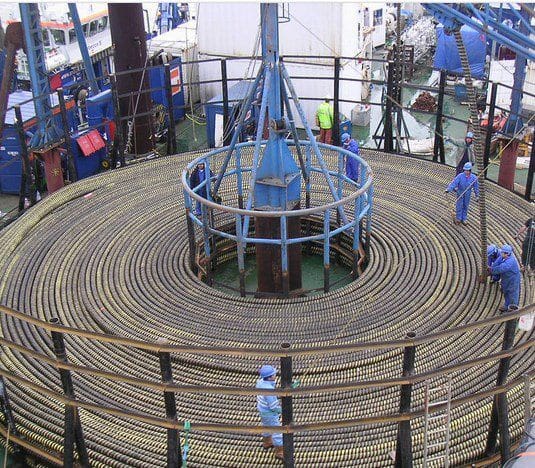
Hexatronic Cables & Interconnect Systems has secured a contract with A-2-Sea Solutions Limited for the supply of rock armored submarine ribbon cable.

In the contract worth 10 million Swedish Crowns ($1.19 million), Hexatronic will supply approximately 20 km of rock armored submarine ribbon cable, for the Isle of Wight to Portsmouth installation project.

The three layer armored cable is designed to withstand demanding undersea conditions. Delivery is scheduled in November 2015, the company said in a press release.

“The contract with A-2-Sea Solutions is important for Hexatronic as we break into a new market with our comprehensive and future-proof submarine cable solutions. This agreement strengthens Hexatronic’s global presence in the subsea telecom cables industry, “says Henrik Larsson Lyon, CEO of Hexatronic Group AB.

Plans for commercial scuba diving facility in Faughart are rejected

0

Plans to retain and complete a partially-built roof top lawn and staircase that was being used for commercial scuba diving have been rejected by Louth County Council.

The local authority recently refused the application from Abbey Commercial Diving Ltd for the facility at Upper Faughart.

Abbey Commercial Diving Ltd was set up by Martin and Desmond McKeown in May 2014 and conducts dives off the North East coast.

They had sought permission for the use of the structure for home based economic use but the matter was rejected by the local authority despite the fact that three neighbours had written to the council in support of the development.

The refused the planning application on three counts – that there was not “justifiable reason” for this development to be defined as an alternative rual based enterprise and that there was no evidence to suggest the location will have no negative impact on the existing and surrounding dwellings. They also said the infrastructure section were not satisfied that adequate sight lines have been provided for a non-domestic development, therefore it could be a traffic hazard.


Source

Ocean Installer Bags Moho Nord Contract Off Congo

0

Ocean Installer has been awarded a contract for deep water UFR installation work with Total E&P Congo at the Moho Nord field off the coast of the Republic of Congo.

The contract is Ocean Installer’s first major operation in West Africa following the creation of the Africa, Mediterranean and Middle East regional office in the second half of 2014, the company said.

“We are delighted to have been chosen for this job in a very competitive market and we are looking forward to cooperate with Total E&P Congo on this complex project. The award reflects our efforts over the last 12 months to bring our proven track record to the African market and validates our geographical expansion strategy,” says Steinar Riise, CEO of Ocean Installer.

The project will see Ocean Installer install and pre-commission an umbilical, Multi-Phase Pump (MPP), flying leads and spools in water depths of around 1,000m. The scope includes project management, engineering and logistics, in addition to offshore work.

The project will be managed from the Ocean Installer Stavanger Head office, whilst the DP3 Construction Support Vessel Normand Vision will be utilised for the offshore execution. She is equipped with a 150Te Vertical Lay Spread (VLS), a 400Te active heave compensated crane and two work class remotely operated vehicles from Oceaneering.

The Moho Nord field is located 75km off the coast of the Republic of Congo in water depths ranging from 450 to 1200 metres. Total E&P Congo holds the operatorship with a 53.5% interest, alongside Chevron (31.50%) and state-owned Société Nationale des Pétroles du Congo (15%).