Home Blog Page 13

Subsea 7 awarded major contract

0

Subsea 7 S.A. (Oslo Børs: SUBC, ADR: SUBCY) today announced the award of a major* EPCI contract for offshore execution in 2017 and 2018. No further details are disclosed at this time due to contractual obligations. A more detailed announcement will be made in the near future.

*Subsea 7 defines a major contract as being over USD 750 million

Subsea 7 S.A. is a leading global contractor in seabed-to-surface engineering, construction and services to the offshore energy industry. We provide technical solutions to enable the delivery of complex projects in all water depths and challenging environments.


Source

Talent in the Time of Bankruptcy: A Primer for the Oil and Gas Industry

0

With oil prices having fallen nearly 70 percent during the past 18 months, oil and gas companies are hunkering down and significantly revising strategies and business plans in an effort to adapt to the new reality. Oil and gas is inherently cyclical, and many companies will survive the current downturn. Some will even thrive, leveraging disruption to their advantage. But others, despite their best efforts, will not make it.

A recent report by Deloitte found nearly 35 percent of pure-play exploration and production (E&P) companies listed worldwide – approximately 175 companies – to be at risk for bankruptcy in 2016, in large part due to the nearly $150 billion of debt carried on their collective balance sheets.1 The sizable number of enterprises in this situation means that many of the industry’s stakeholders should give thought to their response should the possibility of bankruptcy appear.

With bankruptcy, the default inclination is to think in terms of capital and physical assets. But there is a significant talent component as well that can easily be overlooked. Based on the experience of the Egon Zehnder Energy Practice in advising companies through multiple business cycles on senior executive recruiting, leadership succession and board composition and performance, we offer these suggestions to various stakeholders who may find themselves potentially involved in a bankruptcy scenario.

Creditors

Creditors that own fulcrum securities will undertake a thorough due diligence in order to determine the best strategy for the company they now own – including whether or not they want to continue to own it. That due diligence must include an examination of the team they are inheriting. After all, the extent to which the team’s experience, competencies and potential are aligned with the requirements of the investment thesis greatly affects the risk associated with that thesis.

A deep-dive talent assessment should evaluate each leadership team member’s strategic orientation and operational discipline, as well as his or her ability to adapt to and lead through change. The team must also be evaluated collectively against the thesis so that any critical gaps can be identified and addressed. This gap analysis is critical because many current teams were assembled around a growth-oriented “acquire and explore” mandate that is out of step with the present environment.

Boards of Directors

Whether a company must actually undergo bankruptcy or merely steer clear of it during tumultuous times, it is the board of directors that must make the tough calls involving capital structure, asset sales and critical other matters. But a board’s decision-making acumen can be undercut by issues within the board’s structure and culture that are obscured during boom times.

We spoke with the chairman of a $3 billion oilfield services company who noted, “It was relatively easy to mask the limitations of the board when the industry was expanding, but now, in a protracted downturn, tough times call for tough changes. We need a board that is decisive and nimble and that values edge over consensus in order to stretch and challenge assumptions.”

Boards can gain insight into areas where their performance can be optimized through board effectiveness reviews in which experienced facilitators gather information through one-on-one interviews. For example, collegiality might be masking a reluctance to fully debate difficult questions. A highly engaged board may have the side effect of making it hard for the CEO to fully take ownership of the direction of the company. A board effectiveness review identifies undercurrents such as these and provides actionable suggestions to the board chair and the chair of the governance committee.

Having the right mix of backgrounds and experience on the board is an essential requirement for high performance. In particular, many companies are led by younger management teams that can benefit from the advice and counsel of a strategically composed board. Boards can provide a steadying voice to ensure that mistakes from previous downturns are not repeated, such as the “lost generation” that resulted from the gutting of leadership pipelines during the headcount reductions of the 1980s. Indeed, maintaining investment in talent management, including mid-level and senior-level succession planning, is a central message all boards need to be giving to their CEO.

CEOs and CHROs

While it is important for boards to keep talent management and succession planning on the agenda, it falls to the CEO and the chief human resources officer (CHRO) to make that an imperative even when staffing cuts and layoffs dominate the headlines. Focusing on talent may seem like a luxury if the company is fighting for survival, but consider that the current downturn is accelerating the retirement of many senior managers. It would be shortsighted to dodge immediate threats only to be hampered soon thereafter by an acute leadership shortage. So it is that forward-thinking organizations use downturns as opportunities to help emerging leaders gain skills that will make them more valuable in the long term. For example, some oilfield services and agreement companies are taking advantage of the sluggish (and thus low-risk) sales environment by rotating high performers into sales roles to provide customer-facing experience earlier in their development.

“The thing that keeps me up at night is whether we are retaining the right people, the high performers. It’s just too easy to get caught up in the cost reduction treadmill and eliminate top talent three to four levels deep in the organization, forgetting the longer term talent strategy,” noted a CHRO of a global E&P company. “It’s imperative that we develop the next wave of leadership or we will wake up in seven years to find we have lost another generation.”

Communication is an essential part of retention, especially during periods of uncertainty when employees take their cues from company leadership. Despite the number of issues demanding their attention, CEOs and CHROs should ensure that their level of communication is ramped up to meet the needs of their audience. It will be time well spent.

Employees

Understandably, deep turbulence in the business environment creates significant stress among employees. For example, one Eagle Ford driller – typical of some E&P companies active in US shale plays – reported that the number of active rigs run by his asset team dropped from 15 in 2014 to just one 18 months later.

Many employees may find it difficult to respond to this kind of uncertainty by renewing their commitment to the organization, but the fact is that downturns create significant opportunities for employees to increase the value they offer during times of volatility. Employees should proactively look for opportunities and projects that allow them to learn from colleagues with experience from previous cycles and with other parts of the business. At the same time, employees should invest in growing one’s external network, a prudent step given that the future is impossible to predict.

In the end, all stakeholders need to be guided by the principle that current survival must be in the service of a long-term vision for the future. As the CEO of a $10 billion energy company told us, “While we’ve had to cut costs, we can’t lose our focus to innovate: innovation around our operational processes, our administrative processes and those things we can do to become more efficient, more effective and more profitable with the people that we have today.”

Key priorities for each stakeholder constituency during bankruptcy and/or market turbulence

Creditors

  • Conduct management diligence on the teams you may inherit
  • Ensure that management capabilities are aligned with the forward-looking investment thesis

Boards of Directors

  • Ensure that board processes are robust and composition provides varying perspectives to help navigate the downturn
  • Stay engaged – or become more engaged – in talent development

CEOs and CHROs

  • Maintain focus on long-term succession planning
  • Commit to investing in developing (and communicating to) high-potential employees

Employees

  • Find ways to partner with more experienced colleagues to benefit from their knowledge of previous cycles and areas of the business
  • Invest in professional networks, both internal and external

Todd Auwarter is based in the Houston office of Egon Zehnder’s energy practice, and Steven Goodman leads Egon Zehnder’s energy pratice in North America.

Source

Gazprom: First cargo of Yamal oil shipped from Arctic Gate offshore terminal

0

An event marking the start of the year-round shipments of Yamal oil from the Arctic Gate (Vorota Arktiki), an Arctic oil loading terminal, took place today in the Mys Kamenny settlement (Yamal Peninsula, Yamal-Nenets Autonomous Area). The event was attended by Alexey Miller, Chairman of the Gazprom Management Committee, and Alexander Dyukov, Chief Executive Officer of Gazprom Neft.

Russian President Vladimir Putin gave the command via a video call to start loading a tanker with oil from the Novoportovskoye field.

The Novoportovskoye oil, gas and condensate field, the richest in oil reserves in the Yamal Peninsula, is located 700 kilometers away from the existing pipeline infrastructure. That is why it was decided to ship Yamal oil by sea for the first time in the history of Russia’s oil and gas industry.

Thanks to cutting-edge technologies employed in building the production, transportation and, most importantly, loading infrastructure, it took only four years to arrange commercial oil production from the field. It is planned to extract 6.3 million tons of feedstock from the field as early as 2018. The plan for further field development will be outlined before late 2017.

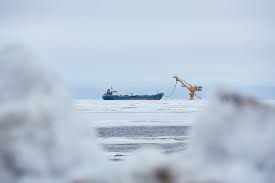
An over 100-kilometer-long oil pipeline transports oil from the Novoportovskoye field to the Ob Bay coast. The bay’s ship channel with a depth of 11 meters is too shallow for ship traffic, which is why the oil loading terminal was placed in the sea, 3.5 kilometers offshore. The annual capacity of the oil transshipment terminal is up to 8.5 million tons. The terminal ensures a year-round loading of tankers with Yamal oil for further shipments via the Northern Sea Route.

The Arctic Gate offshore oil terminal is a unique facility. It is designed to operate under extreme natural and climatic conditions, as temperatures in the region can drop below minus 50 degrees Celsius and ice can grow over two meters thick. The terminal has a two-tier protection system and complies with the most stringent requirements for industrial safety and environmental protection.

The terminal’s equipment is fully automated and safely protected from hydraulic shocks. A special system allows for prompt undocking without depressurizing the units undergoing disconnection. The zero discharge technology prevents foreign substances from getting into the Ob Bay, which is of paramount importance to the preservation of the Arctic environment. Moreover, the subsea pipeline that connects the terminal to the coastal tank battery is protected with an additional concrete shell.

“Gazprom is systematically exploring the Russian Arctic. We are successfully extracting oil from the Prirazlomnoye field, Russia’s only hydrocarbon production project on the Arctic shelf. A one-of-a-kind gas production center in the Yamal Peninsula is in full swing. Today, we are creating a new oil province on top of the gas center. We have opened the Arctic Gate to deliver Yamal oil to European consumers via the Northern Sea Route all year round,” said Alexey Miller, Chairman of the Gazprom Management Committee.


Source

Saudi Aramco Lifted 2015 Oil Output to Record in Market Spat

0

Saudi Arabian Oil Co., the world’s largest crude producer, increased output to an all-time high last year while keeping its reserves unchanged as the kingdom battles for market share.

Saudi Aramco, as the state-owned company is known, produced 10.2 million barrels a day of crude in 2015, up from 9.5 million in 2014, according to an annual review posted on its website Thursday. Natural gas output rose to 11.6 billion standard cubic feet a day from 11.3 billion. The company discovered three oil deposits last year, the same as in 2014, while gas field discoveries declined to two from five.

“Expanding oil and gas supplies to meet the needs of domestic and international markets is at the core of Saudi Aramco’s business, and in 2015 the company delivered on its commitments, reaching record levels of oil production and gas processing,” Chairman Khalid Al-Falih said in the review.

Saudi Arabia’s rising production, along with increased output from shale plays in the U.S. last year, exacerbated a global supply glut that drove down benchmark prices by more than 30 percent in 2015.

Market Share

OPEC, led by Saudi Arabia, chose in November 2014 to keep pumping crude to protect its share of the market rather than cutting output to boost prices. Last month, the Organization of Petroleum Exporting Countries and other major producers including Russia failed to reach an agreement over a proposal to freeze output after Saudi Arabia insisted that it couldn’t sign up to a deal without the participation of Iran, which has pledged to boost its own oil production to pre-sanctions levels before considering a cap.

The Saudi company’s oil reserves were unchanged at 261.1 billion barrels, while those of gas increased to 297.6 trillion standard cubic feet from 294 trillion. The company said it maintains an oil-production capacity of 12 million barrels a day.

Saudi Aramco is undergoing a major transformation that will include selling less than 5 percent of its shares to the public by the end of 2018. The company’s restructuring plan will be announced within six months, Deputy Crown Prince Mohammed bin Salman said in an interview in Riyadh on April 15. After the IPO, Saudi Aramco will become a holding company that is not involved in the daily management of its subsidiaries, he said.

More Exports

The company exported 2.6 billion barrels of crude in 2015, or 7.1 million barrels a day, up from 2.54 billion in 2014.

Saudi Aramco’s exports to major Asian markets increased “substantially” last year from a year earlier, with shipments to India jumping 18 percent. Exports to China grew 4.5 percent. The company said it was able to maintain the same level of exports to U.S. market at 1 million barrels a day “despite competition from shale oil.”

The company said it expanded its geographical sales area and opened new markets last year in the Baltic. Aramco also “enhanced its role as a supplier” through increasing sales of spot cargoes to its customers in Asia and Europe last year from its storage facilities in Okinawa and Rotterdam, it said.

The operation of new local refineries helped Saudi Aramco’s exports of petroleum products to increase by 38 percent.

Refining Capacity

Saudi Aramco’s fully owned oil-refining capacity was 3.1 million barrels a day at the end of last year, the same as in 2014, according to the report. The company’s total refining capacity was 5.4 million barrels a day in 2015. Saudi Aramco is seeking to double its refining capacity to 8 million to 10 million barrels a day, Chief Executive Officer Amin Nasser said in March.

Saudi Aramco said in the review that it’s expanding its Rabigh Refining & Petrochemical venture with Sumitomo Chemical Co. The second phase of the project will increase the production capacity of the ethane cracker, add a new world-scale aromatics complex and create 22 process plants. The project will start commissioning in mid-2016.

Last year, Saudi Aramco began exploring the development of a chemicals complex to be integrated with its SATORP joint venture with Total SA, it said.


Source

Shell buys award-winning subsea pump technology

0

Sulzer and FMC Technologies have received a subsea multiphase boosting pump contract to upgrade one of the pumping modules in Shell’s Parque das Conchas, a deepwater oil field off the coast of Brazil. The pump modifications suit the specifics of the oil field with a high shut-in pressure of 517 bar (7 500 psi). They meet Shell’s maintenance and service needs with high reliability and short turnaround intervention.

The Parque das Conchas, also known as the Shell BC-10 field, is situated in deep water, approximately 120 km (75 miles) southeast of the Brazilian coastal city of Vitória. The BC-10 asset has water depths ranging from 1 500 to 2 000 meters. It is operated by Shell, with a 50% working interest. ONGC Videsh and Qatar Petroleum International are joint venture partners with 27% and 23%, respectively.

A key part of the success of the project has been the collaboration between Shell, FMC Technologies, and Sulzer. The subsea pump will be manufactured from a global supply chain with a large amount of assembly and testing conducted at Sulzer’s facilities in the United Kingdom.

The advantage of the mudline pump is that it fits into an existing infrastructure with minor and cost-efficient modifications, yet is smaller and lighter than the pump it replaces. Smaller does not mean less performance: The pump achieves the necessary oil volume and boosting outputs.

This first subsea pump for Shell from FMC Technologies and Sulzer will be launched in the field in 2017. It will demonstrate the pump’s capability to maintain yield levels and achieve excellent reliability targets in the harsh deep-sea environments.

Source

Saudi Aramco Says Discovers New Fields, to Continue Energy Investments

0

Saudi Arabia’s state oil giant Aramco discovered new oil and gas fields last year and the kingdom is committed to continue investing in its energy sector to meet future demand, its new energy minister said.

Khalid al-Falih, who was appointed energy, industry and mineral resources minister on May 7 and is also Aramco’s chairman, said that despite low oil prices, the company has reached record levels of oil production and gas processing.

“Declining investments by energy producers raise concerns about another cycle of supply constraints and therefore more market volatility,” Falih said in Aramco’s 2015 annual report.

“Saudi Arabia … is committed to sustaining its investments in hydrocarbon-based energy to meet future demand and power sustainable economic growth at home and around the world.”

His comments are a further sign that Saudi Arabia, the world’s largest oil exporter, does not intend to restrict supply as it battles for market share with other top producers.

Aramco, the world’s largest oil company, which is preparing a stock market listing to sell a small portion of its shares, has discovered three new oil fields, it said in the report. They are Faskar, offshore in the Arabian Gulf near the Berri field; Janab, east of the Ghawar field; and Maqam, in the eastern Rub’al-Khali.

It has also found two new non-associated gas fields – Edmee, located west of Haradh, and Murooj in the Empty Quarter.

The company pumped an average of 10.2 million barrels per day in 2015, a new all-time record. Its exports averaged 7.1 million bpd, up from around 6.8 million bpd in 2014.

Saudi Aramco remained the No. 1 one crude supplier to six major Asian countries – China, Japan, South Korea, Taiwan, the Philippines, and India – it said in the annual report. Asia accounted for 65 percent of its total oil exports; an increase from 62.3 percent a year earlier.

“Despite competition from shale oil, the company’s exports to U.S. markets maintained their level of 1 million barrels per day,” Aramco said.

Aramco’s CEO told Reuters in an interview on Thursday that the company is gaining market share and pushing for greater efficiency.

As part of efforts to maximise revenues and expand market share Aramco is building new refineries to secure long-term agreements to sell its crude.

It said its crude oil and condensate throughput to its domestic wholly owned and joint venture refineries rose 9 percent in 2015, mainly due to the commissioning of its new Jubail refinery, known as Satorp, and the full operation of its Yanbu Sinopec refinery, Yasref.

Its exports of refined products rose 38 percent last year.

Aramco said it was moving ahead with its programme to explore for gas in the shallow waters of the Red Sea as well as unconventional gas.

Its crude oil reserves were stable at 261.1 billion barrels in 2015, while gas reserves rose to 297.6 trillion standard cubic feet from 294 trillion standard cubic feet in 2014.

Source

Statoil drills minor oil discovery and dry appraisal well southwest of the Oseberg Sør field in the North Sea

0

Statoil Petroleum AS, operator of production licence 035, is in the process of concluding the drilling of wildcat well 30/11-12 S and appraisal well 30/11-12 A.

The wells were drilled two kilometres south of the 30/11-9 A (Askja Øst) discovery, and about 35 km southwest of the Oseberg Sør facility in the North Sea.

The objective of well 30/11-12 S was to prove petroleum in three sandstone layers in Middle Jurassic reservoir rocks (the Tarbert formation). The objective of well 30/11-12 A was to delineate in the event a discovery was made in 30/11-12 S.

30/11-12 S encountered a 37-metre oil column in the upper part of the Tarbert formation, of which about 30 metres had good to moderate reservoir properties. Well 30/11-12 A, which was drilled further down on the structure, encountered similar reservoir rocks, but is dry.

Preliminary estimates place the size of the discovery at between 0.7 and 2.5 million standard cubic metres (Sm3) of recoverable oil equivalents. The discovery will be included in the evaluation of a new field development, along with other earlier discoveries in the area.

Data has been collected and samples have been taken in both wells.

Wells 30/11-12 S and 30/11-12 A were drilled to vertical and total depths of 3669 and 3671 metres, respectively, and 3609 and 4144 metres below the sea surface. 30/11-12 S was terminated in the Ness formation and 30/11-12 A was terminated in the Tarbert formation.

The wells are the 12th and 13th exploration wells in production licence 035. The licence was awarded in the 2nd licensing round in 1969.

Water depth is 110 metres. The wells have been permanently plugged and abandoned.

Wells 30/11-12 S and 30/11-12 A were drilled by the Songa Delta drilling facility, which will continue its drilling campaign with the drilling of wildcat well 30/11-13 S in the same production licence, where Statoil Petroleum AS is the operator.


Source

Oil States Expected To Stick With Saudis: OPEC Reality Check

0

OPEC members gathering in Vienna June 2 are expected to go along with a Saudi Arabia-led policy focused on squeezing out rivals amid signs the strategy is working. That means the meeting may be less fraught than the previous summit in December, which ended with public criticism of the Saudi position from Venezuela and Iran.

By allowing prices to fall, high-cost producers are being forced out, easing the supply glut and spurring a rally of 80 percent since January to about $50 a barrel. All but one of 27 analysts surveyed by Bloomberg said the Organization of Petroleum Exporting Countries will stick with the strategy. An alternative proposal — to freeze output — was finally rejected in Doha last month.

The group may also choose a secretary-general to replace Abdalla El-Badri, whose term has been extended after members failed to agree on a successor. In recent months, three new hopefuls have emerged to try and break the impasse: Nigeria’s Mohammed Barkindo, Indonesia’s Mahendra Siregar and Venezuela’s Ali Rodriguez.

Following are the latest comments from OPEC members and analysts. The respective shares of supply are based on April levels. The estimates for the price each member needs to balance its budget are from the International Monetary Fund unless stated otherwise.

Algeria

Price needed: $87.6 Share of OPEC production: 3.3 percent

Algeria tried, and failed, last year to organize a meeting of non-OPEC/OPEC members to push for output cuts, as years of declining crude production and low prices weighed on its fiscal deficit. A freeze by producers is needed immediately to stabilize prices, Salah Khebri, minister of energy and mines, said in an interview mid-May. “Our main message to the next OPEC meeting is that it needs to restore unity and work for the benefit of all members collectively,” he said.

Angola

Price needed: $93.14 (RBC Capital Markets) Share of OPEC production: 5.4 percent

Angola is seeking an IMF loan as state revenue plunges. Its over-reliance on strong oil prices leaves savings and levels of inward investment ‘‘highly vulnerable’’ to swings in the global economy, Fitch unit BMI Research said in e-mailed report.

Ecuador

Price needed: $75.16 (RBC Capital Markets) Share of OPEC production: 1.7 percent

Ecuador supported an oil-output freeze at the Doha meeting. Minister Jose Icaza met with his Venezuelan counterpart before the summit to discuss prices and seek to agree on a unified position. Icaza became Ecuador’s new oil minister in early May following the resignation of Carlos Pareja.

Indonesia

Unlike other OPEC members, Indonesia is still a net oil importer so the fiscal break-even concept is not applicable. Share of OPEC production: 2.2 percent

Indonesia rejoined OPEC at the Dec. 4 meeting, seven years after suspending its membership. It will stick to its plan to increase oil output this year even if some of the world’s biggest producers move to cap production, Energy and Mineral Resources Minister Sudirman Said said in February.

Iran

Price needed: $61.5 Share of OPEC production: 11 percent

The Persian Gulf nation is rebuilding its energy industry and restoring crude sales after the lifting of international restrictions in January. Exports are already at 2 million barrels a day, just short of pre-sanctions levels, the IEA said in a recent monthly oil market report. The head of the state oil company said the country — a key advocate of output restraint in previous years — has no plans to join any output freeze as it remains focused on restoring exports.

Iraq

Price needed: $59.7 Share of OPEC production: 13 percent

Production has jumped more than 40 percent since mid-2014 and exports are at near-record levels. But plunging government revenue is hampering the state’s ability to invest, and OPEC’s second-biggest crude producer is reaching the limits of its capacity to store and export oil, according to analysts at Energy Aspects Ltd. and FGE. Oil Minister Adel Abdul Mahdi resigned in February amid ongoing political turmoil, his duties are being carried out by Fayyad Al-Nima.

Kuwait

Price needed: $52.1 Share of OPEC production: 8.7 percent

Kuwait plans to boost oil production to more than 3 million barrels a day within months, doubling output from where it stood during April’s oil-worker strike. Kuwait’s acting Oil Minister Anas Al-Saleh, said on May 18 that OPEC’s policy “has been working well.”

Libya

Price needed: $195.2 Share of OPEC production: 0.9 percent

OPEC’s smallest producer. Competing administrations of Libya’s state-run National Oil Corp. in the east and west of the divided country agreed May 17 to resume exports from Hariga port to help revive production, which has dropped 80 percent since the 2011 uprising that ousted Muammar Qaddafi. It isn’t clear if it will send anyone to the meeting; it didn’t attend the Doha freeze talks in April.

Nigeria

Price needed: $104.49 (RBC Capital Markets) Share of OPEC production: 5.1 percent

A resurgence in militant attacks in Nigeria’s oil-producing region has cut output to the lowest in 27 years, helping buoy global prices. An armed group calling itself the Niger Delta Avengers has warned of more attacks to come.

Qatar

Price needed: $52.4 Share of OPEC production: 2 percent

Mohammed Al Sada, Qatar’s minister of energy and industry who is also president of OPEC, said global demand is catching up with supply and the market should see a “rebalancing” in the second half of the year as cheaper crude has forced some production to close. Qatar is expected to swing into a budget deficit this year, according to the IMF.

Saudi Arabia

Price needed: $66.7 Share of OPEC production: 31 percent

Saudi Arabia will probably keep producing crude at near-record levels under new Energy Minister Khalid Al-Falih, an ally of Deputy Crown Prince Mohammed bin Salman. Prince Mohammed scuppered the oil-freeze plan, and Al-Falih’s appointment points to an “exceedingly high probability that there will be no Saudi agreement to freeze let alone cut production,” analysts including Ed Morse said in an e-mailed note dated May 9.

United Arab Emirates

Price needed: $71.8 Share of OPEC production: 8.9 percent

U.A.E. still supports stability in the oil market, said Matar al Neyadi, the undersecretary of the energy ministry.

Venezuela

Price needed: $121.06 (RBC Capital Markets) Share of OPEC production: 7.4 percent

Venezuela is one of the so-called Fragile Five OPEC members most at risk from significant instability amid the turmoil in prices, according to RBC Capital Markets LLC. Energy Minister Eulogio Del Pino was one of the most ardent advocates of the failed production-freeze agreement. While the country’s economy remains in critical condition, Caracas is probably resigned to the course set by Riyadh, said Jason Bordoff, director of the Center on Global Energy Policy at Columbia University in New York.

Source
Focused on workflow efficiency, Statoil adopts IHS Kingdom as its primary geoscience interpretation platform for US onshore assets, IHS says

0

Following a performance-based assessment, Statoil, one of the world’s leading energy producers, has selected the IHS Kingdom® geologic and geophysical interpretation software suite as its primary geoscience workflow platform for the company’s U.S. onshore operations, according to IHS (NYSE: IHS), the global source of critical information and insight.

IHS Kingdom is the industry leading Microsoft Windows®-based geoscience software interpretation tool used by thousands of geoscientists in more than 80 countries to evaluate potential oil and gas reservoirs and plan field development.

A technology leader and pioneer in unlocking hydrocarbons from U.S. shales, Statoil has leveraged its acreage holdings and its expertise in both drilling techniques and the geology of the leading shale plays to grow into a company that produced nearly 91 thousand barrels of liquids per day, and 818 million cubic feet of natural gas per day during first-quarter 2016, on an equity-volume basis.

“Statoil’s U.S. unconventional assets represent approximately 11 percent of the company’s current equity production, which is produced from the Bakken, Eagle Ford and Marcellus plays,” according to Sam Hanna, senior principal equity analyst at IHS, who covers Statoil.

“In today’s challenging commodity market, the fit-for-purpose efficient tool set is the key driver for an operator’s limited staff,” said Russell Roundtree, vice president of geoscience and engineering at IHS. “With geoscientists working on unconventional and conventional oil and gas resource plays, Statoil’s requirements for a streamlined enterprise-level geologic and geophysical analytical toolset have grown substantially during the last several years. We are extremely pleased to provide the solution that best fits their expanding business needs, and to have our IHS Kingdom Geoscience software platform adopted by Statoil.”

According to Roundtree, Statoil selected IHS Kingdom as its primary geoscience workflow platform for the company’s U.S. onshore operations after running an exhaustive evaluation of all the top upstream integrated application suites. IHS was found to provide the most intuitive, efficient, yet powerful application suite to meet their business needs.

IHS Kingdom enables geologists and geophysicists to conduct dynamic depth conversion of time-based geophysical data — transforming a common time-intensive geosciences workflow that used to take hours to process can now be accomplished in seconds.

Said Roundtree, “IHS Kingdom, and its dynamic depth-conversion capability, has been described by some of our customers as being truly ‘transformational.’ Some customers have made it a best-practice requirement for the company’s drilling and geoscience teams due to its unprecedented ability to keep the horizontal wellbores within the productive target zone of the reservoir and optimize the productivity of these costly long laterals. We are excited to see Statoil incorporate this innovative technology into their workflows.”


Source

Shell CEO Warns Renewables Shift Could Spell End If Too Swift

0

Royal Dutch Shell cannot switch too quickly to producing renewable energy without risking its dividend payments and even its very existence, the oil and gas group’s chief executive warned.

Major investors, including Dutch pension fund PGGM, have criticised Shell’s climate change policy in recent months, saying it should do more to mitigate climate change risks.

However, 97 percent of Shell shareholders at its annual meeting on Tuesday rejected a resolution to invest profits from fossil fuels to become a renewable energy company. The Anglo-Dutch firm had previously said it was against the proposal.

Chevron and Exxon face similar climate change resolutions at their annual meetings on Wednesday, highlighting growing investor concern about oil and gas companies’ exposure to a warming climate after world powers agreed to tougher emissions cuts in Paris last year.

Shell Chief Executive Ben van Beurden said that the oil and gas industry will nevertheless need to invest up to $1 trillion per year, even while meeting the U.N.-backed goal of curbing carbon emissions to limit the rise in global warming.

Making a switch to other forms of energy would take time, Van Beurden said, adding that all the top 10 solar companies in the world represent $14 billion in capital employed and invested $5 billion in solar energy last year, but none had so far paid any dividends.

“We cannot do it overnight (transition to renewables) because it could mean the end of the company,” he said.

And growing demand for oil and gas in emerging economies means investments in the oil industry will have to continue.

“It will take an unprecedented amount of effort to bring about a net zero emissions future,” he said.

“If collectively we find a way to stay within the 2 degree (Celsius limit), we will still need significant investment in oil and gas…I am talking about up to a trillion dollars every year,” van Beurden added.

Europe’s top oil companies, including France’s Total and BP have stepped up their push towards renewables in recent months in the wake of an international climate change treaty in Paris last year, where nations agreed to limit global warming by cutting hydrocarbon use.

Shell, Europe’s biggest oil company, is also setting up a dedicated ‘new energies’ unit that will incorporate its wind and solar as well as hydrogen and biofuel investments, an internal memo seen by Reuters showed.


Source