Home Blog Page 135

Scientific Diving: The Benefits of Being There

0

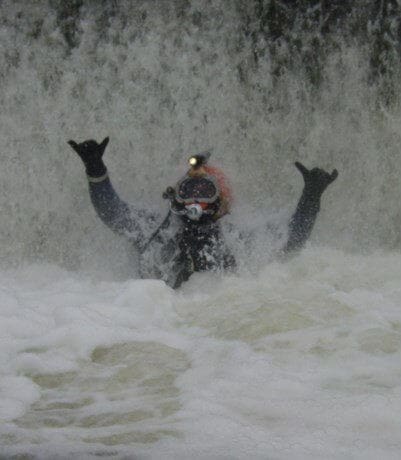
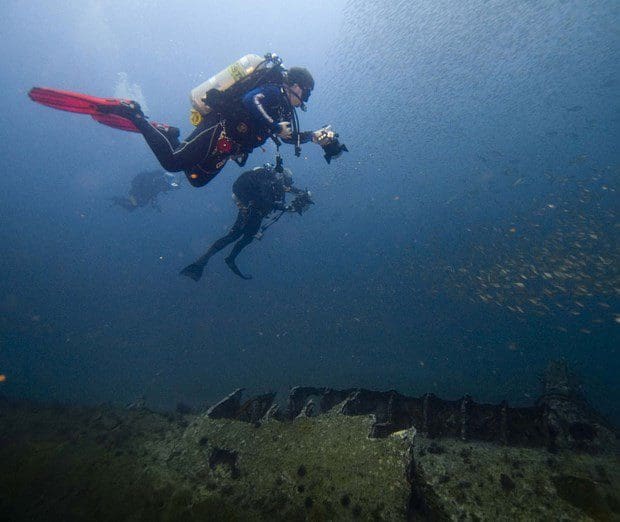
Leah Houghton pulls on her wetsuit, shrugs into her weight belt, tank, and buoyancy vest, then slips over the side of a boat into balmy seas to count baby fish hiding in coral crevices. Erich Horgan hovers 60 feet below the sea surface, scanning the blue space that surrounds him and the four other divers attached to him by 30-foot lines. Pat Lohmann dons a dry suit on a wintry day on Cape Cod—the multiple layers take half an hour to put on—then grabs his tools and splashes into the icy seawater to switch out batteries on underwater instrument.

All three are researchers at Woods Hole Oceanographic Institution (WHOI) who were doing scientific scuba diving, a valuable but unheralded means of doing oceanographic research.

Oceanographers use tools and techniques ranging from nets to autonomous robots. Most measure or take samples while scientists stay on board a ship or ashore. Instruments can substitute for people’s hands and eyes, taking measurements more frequently, for longer timespans, in deeper waters and worse conditions than people can. But scuba is the one technique lets the scientists extend their ownreach under water.

“The diving program at WHOI provides access to the shallow ocean for people who need to observe or manipulate things, in places where you can’t do that with a remote device,” said Larry Madin, WHOI director of research and a scientific diver. “It’s much more effective to be there in person and be able to see what you’re doing.”

In the 1950s and 1960s, as scuba diving became popular for recreation, it also became a standard tool for research and equipment support. Scientific diving, though, is not the same as recreational scuba diving, even when it’s done in the same places.

“We distinguish scientific diving from both recreational diving on the one hand and commercial diving on the other,” said Madin. “Recreational divers go to have a nice time and can go or not as they choose. Commercial divers, on the other hand, work in difficult conditions, have a job to do, and a schedule to meet.

“Somewhere in between is scientific diving: We have a job to do, but it’s a job of our own choosing, because it’s our own research. We have a certain amount of choice in how we do it, but it’s more than just going for fun, and we’re probably going to be using more complex or unusual equipment than a recreational diver, doing tasks we need to complete in a certain time length, and being responsible for collecting data and samples, and at the same time, for diving safely and looking after the people with us.”

Scientific diving requires specialized training, and the WHOI diving program provides that. WHOI has had just three diving safety officers: David Owen (1953-1980), Terry Rioux (1980-2010), and Edward O’Brien (currently). The program they developed over the years has trained and certified 418 divers in all, preparing them for whatever conditions their research requires and helping them maintain their expertise.

“It isn’t leisure,” said O’Brien. We have a saying here: The science controls the diving.” Divers come to him with a problem, describing what they want to do under water, he said. Then they talk about it and come up with a solution that safely enables the research.

“It’s all in the training,” he said. “Everything’s possible if you take it in small bits and focus on the task.”

WHOI belongs to the American Academy of Underwater Sciences (AAUS), the professional organization established by scientific divers from research institutions around the country. AAUS defines what scientific diving consists of, promotes safe procedures and guidelines, and keeps track of safety records. A diver certified at WHOI can travel to another AAUS institution and be accepted as a diver with acknowledgement of their qualifications.

These three narrated audio slideshows profile different kinds of diving that WHOI researchers do in the course of their work.


Source


Global Marine to Lay New Cables for ONC’s Neptune Observatory

0

Global Marine Systems, the UK based subsea cable route design, installation and maintenance specialist, has secured a contract from Ocean Networks Canada, to upgrade the fibre-optic cables serving the Neptune observatory off the west coast of Canada.

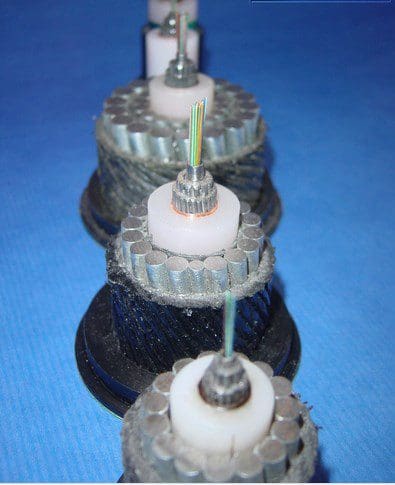
The subsea infrastructure of Neptune comprises an 800 km loop of fibre optic cable connected to various instrumented sites (nodes). The observatory enables scientists continuous long-term, high temporal resolution observations. The shore station at Port Alberni on Vancouver Island sends the collected data via fibre optic cable to the University of Victoria and out to the world via the Internet.

The contract with Global Marine was signed in September and includes two parts. The first, which was completed in October 2015, was the recovery of failed cables from the Neptune system. The second is the cable installation of new subsea cables, which is scheduled for May 2016.

The Project

The cable recovery work for the Neptune observatory was performed by Global Marine’s vessel, Wave Venture. There were four sections of broken cable identified for recovery, measuring 4750, 7962, 3500 and 1560 metres in length, at water depths of between 2100 and 2400 metres.

Although the recovery work proved relatively straightforward, according to Global Marine, the installation of new fibre optic cables next year is expected to provide a far greater engineering challenge. The difficult task is in part down to the fact that the mechanical subsea structures weighing circa 1.8 tonnes each, will make storage and vessel loading far from simple.

Four cables in total will each feature a mud-mat at each end that helps secure the cable in place. The subsequent task will be accurate deployment on the seabed, using a ROV to connect existing seabed cables to the structure.

“We are extremely pleased to assist Ocean Networks Canada and ultimately the University of Victoria continue their important deep sea research in the region,” says John Walters, Director of Maintenance at Global Marine. “Our in-house teams offer proven capabilities in the delivery of fully engineered end-to-end solutions that meet a vast array of customer requirements. The Neptune installation is a case in point, where Global Marine is providing both installation services and on-going maintenance solutions during the system’s lifetime.”

Taking the Plunge A Guide to Starting an Underwater Welding Career

0

A Special Report from the American Welding Society

CryoGas International examines the many ways the industrial gas industry works with water. The demand for highly sophisticated underwater procedures and technologies is increasing, driven by deep sea oil and gas development and by marine infrastructure development and repair around the world. In this article the American Welding Society (AWS) looks at careers in underwater welding.

For prospective underwater welder-divers, the American Welding Society Subcommittee on Underwater Welding provides answers for nine commonly asked questions in “Taking the Plunge: A Guide to Starting an Underwater Welding Career,” (copyright ©AWS). This article summarizes that report.

This article was prepared by the American Welding Society’s D3B Subcommittee on Underwater Welding.

  1. What skills are prerequisite to entering the field of underwater welding?
    • A welder-diver is a certified welder and commercial diver, capable of performing tasks associated with commercial sub sea work, weld set up and preparation, and who has the ability to weld in accordance with the AWS D3.6M, Underwater Welding Code, wet or dry, and perform other weld-related activities.
  2. I am a certified surface welder; what other training do I need to qualify as a welder-diver?
    • The majority of work performed by an average welder-diver involves executing the tasks that lead up to and follow the actual welding activities. In most cases, a welder-diver must possess both certified welder skills and commercial diving skills.

      If a welder has no prior commercial diving experience, attending a recognized commercial diving school is required. Expect to begin your career as a diver tender (apprentice diver). The average time that this phase takes for most candidates is two years. Most diving contractors will require that you achieve sufficient skill in wet and/or dry underwater welding to pass qualification tests and be certified in accordance with the requirements of AWS D3.6M, Underwater Welding Code.

  3. I am already a certified diver; what other training do I need to qualify as a welder-diver?
    • We recommend the specifications described in AWS D3.6M as a reference for weld procedure and welder qualification. If you are already certified as a “commercial diver,” contact companies that offer underwater welding services and train to their requirements. Underwater welding is a skill you have to master once you obtain the basic commercial diving skills.

      If you are certified as a “scuba diver” (e.g., NAUI, PADI, etc.), please note that sport dive training does not include the safe use of commercial diving equipment, offshore commercial work environment/safety, and other education as recommended by the Association of Diving Contractors Consensus Standards for Commercial Diving Operations.

  4. Where can I obtain the further training I need to get started in this field?
  5. What are the age limitations of a welder-diver?
    • There is no age restriction on commercial welder-divers, but it is recommended and generally required that all commercial divers pass an annual dive physical.
  6. What is the availability of work for an entry-level welder-diver?
    • There are a number of diving procedures that serve the various types of underwater industrial requirements, each of which have different underwater welding needs. Like many professions, work availability is subject to supply and demand, the economics of a given industry, whether you are free to relocate outside your place of residence (including overseas), what other related skills you have in addition to diving and welding, etc.
  7. What salary can I expect to make as a welder-diver?
    • Salaries for welder-divers cover a wide range, from $100,000 to $200,000 per year. The majority of welder-divers are paid on a project-by-project basis and salaries are subject to the same variables as work availability. In addition, other factors such as depth, dive method, and diving environment affect pay rates.
  8. What other skills are recommended to supplement my qualifications as a welder-diver?
    • Welder-diver qualifications vary from project to project. Possessing the skills that are common to underwater welding operations, in addition to welding and diving, are recommended. These skills include: underwater cutting; fitting and rigging; inspection and nondestructive testing; drafting; and underwater photography. The most desirable underwater welder-divers are qualified to assist the diving contractor in pre-job planning; be able to cut, clean, rig, install, and fit up the sections they will weld; and work with personnel responsible for inspecting the completed welds. Formal training is recommended and maintaining qualifications is important.
  9. What future career opportunities are there for an experienced welder-diver?
    • There are a number of career opportunities for experienced welder-divers. Industry has and will continue to demand higher quality standards for underwater welds and more certification of underwater welding systems and personnel. These demands will challenge the underwater welding community to meet more complex technical specifications, safety standards, welding criteria, inspection methods, environmental factors, and other considerations. Many welder-divers go on to become engineers, instructors, and diving operation supervisors, and superintendents fill management positions, qualify as AWS Certified Welding Inspectors (CWI), and serve as consultants for underwater welding operations and other related fields.

Please note: the answers to the questions presented in the article are not intended as recommended practice or as endorsement of any definitive means of pursuing underwater welding as an occupation.

For more information on careers in welding, or to learn more about the new D3.6M:2010, Underwater Welding Code, visit the AWS website at www.aws.org or call 305-443-9353.


© 2011 American Welding Society
550 LeJeune Rd., Miami, Florida, USA 33126
Tel. 305-443-9353  •  Fax 305-648-1655
www.aws.org
e-mail: nbradley@aws.org


Source

New Seabed Monitoring Project to Aid Marine Habitat Protection

0

An Interest group has been formed for project looking at innovative technology to measure seabed scour, erosion and silting.

Called ‘EXPOSURES’ the project, funded by EU, is working to establish a new marine information data collection system which can be exploited for the benefit of commercial marine applications such as the measurement of scour around wind turbine foundations and the managing of coastal erosion and silting.

Through the development and use of advanced underwater ‘Internet of Things’ infrastructures the project plans to create innovative data that will be invaluable in helping protect the marine environment and assisting with the sustainable exploitation of the sea’s resources.

Focussing initially on seabed monitoring, using autonomous systems, EXPOSURES will show how new seabed bathymetric data can be integrated seamlessly with data and models from other sources (e.g. archived survey data) to generate high value information for a wide range of users of coastal waters and seabed resources.

The EXPOSURES pilot infrastructure has already been designed, built and deployed at the ‘SUNRISE ‘ ‘Internet of Things’ facility in Porto, Portugal and will be used to undertake a series of live field trials. These will cover two specific applications that have been identified which have significant socio-economic importance to the marine industry and government agencies; scour around wind turbine foundations and managing erosion and silting. During the project evidence will be generated which will contribute directly to the technical and business validation of the EXPOSURES platform.

Although the project will be focussed on the two initial uses, establishment of this innovative technology will enable it to be used across a broad range of marine applications.

To ensure the technology is developed to full effect, the project partners, IT Innovation (University of Southampton) and Marine South East are facilitating the EXPOSURES ‘Interest Group’. Through this, potential end-users and other interested parties from the marine industry, government agencies and scientific community will be able to learn more about the project. They will be able to engage with the project team and contribute directly to developments maximising applicability, commercial potential and fostering market creation.

The 12-month project will aim to demonstrate that the EXPOSURES platform is viable, and by summer 2016 the intention is to have a stakeholder consortium and strategy to take the technology to the next phase. Field trials are planned for early 2016 and will be followed by a Validation Workshop hosted by HR Wallingford in early April.

Baker Hughes: US Oil Drillers Cut Rigs For 12th Week In Last 13

0

U.S. energy firms cut oil rigs for a 12th week in the last 13, data for the holiday-shortened week showed on Wednesday, a sign drillers were still waiting for higher prices before returning to the well pad. Drillers removed nine oil rigs in the week ended Nov. 25, bringing the total rig count down to 555, the least since June 2010, oil services company Baker Hughes Inc said in its closely followed report.

Baker Hughes issued the report two days earlier than usual due to the U.S. Thanksgiving Day holiday. That decrease brings the total rig count to about a third of the 1,572 oil rigs operating in same week a year ago. Since the end of the summer, drillers have cut 111 oil rigs. U.S. oil futures averaged $42 a barrel so far this week, up from $41 last week, but was down about 1 percent so far on Wednesday as the dollar gained and investors focused on a deep global supply glut.

U.S. crude prices gained 20 cents after Baker Hughes issued the report, briefly pushing the front-month into positive territory, before quickly returning to near flat at $42.72 a barrel at 1:19 p.m. EST (1819 GMT).

Energy traders noted the rate of weekly oil rig reductions since the start of September, about nine on average, was much lower than the 18 rigs cut on average since the number of rigs peaked at 1,609 in October 2014, due in part to expectations of slightly higher prices in the future. U.S. crude futures for next year were trading around $47 a barrel, up from $45 last week, according to the full year 2016 calendar strip on the New York Mercantile Exchange.

Higher prices encourage drillers to add rigs. The most recent time crude prices were much higher than now was in May and June, when U.S. futures averaged $60 a barrel. In response to those higher prices, drillers added 47 rigs over the summer. Drillers cut rigs in all four of the major U.S. shale oil basins this week.

They removed five rigs in the Permian in West Texas and eastern New Mexico and one each in the Niobrara in Colorado and Wyoming, the Eagle Ford in South Texas and the Bakken in North Dakota and Montana. This week’s removal of both oil and natural gas rigs – gas rigs were down four – brought the total rig count down to a fresh 13-year low. 


Source

JOIDES Resolution to Kick Off IODP Atlantis Bank Expedition

0

The IODP (International Ocean Discovery Program) Scientific Expedition 360, “Southwest Indian Ridge Lower Crust and Moho” will begin on December 1, with the JOIDES Resolution.

This expedition aims to drill through the Atlantis Bank gabbroic massif to elucidate the nature of lower crust and Moho at slow spreading ridges. A total of 29 scientists including four from Japan and those from the U.S., Europe, China, South Korea, Australia and Brazil will go on board.

The International Ocean Discovery Program (IODP) is a multinational cooperative project started in October 2013. A total of 26 nations are currently participating: Japan, the U.S., 18 European countries, China, South Korea, Australia, India, New Zealand and Brazil.

The scientific drilling vessel D/V Chikyu operated by Japan and the JOIDES Resolution by the U.S, and the option to charter mission-specific platforms by Europe are utilized for expeditions. It aims to shed light on global environmental changes, the earth’s mantle and crust dynamics and tectonics, and the biosphere beneath the seafloor.

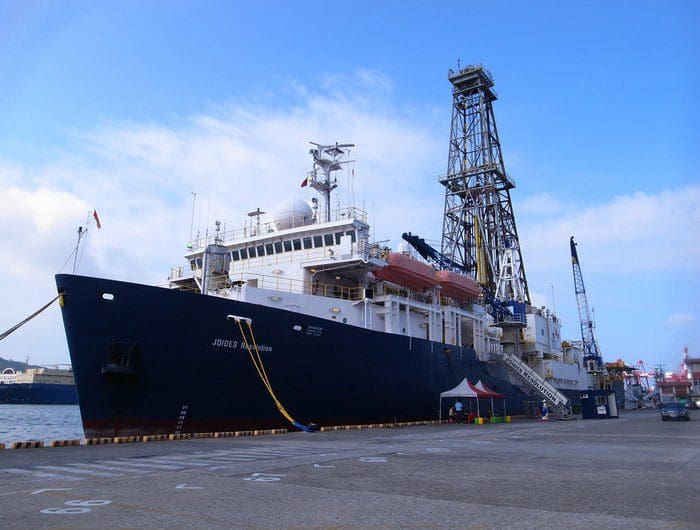
The JOIDES Resolution is the U.S. drilling vessel operated for IODP. Compared to the deep-sea scientific drilling vessel Chikyu by JAMSTEC, it is used more often for drilling in shallow waters.

VIDEO: Fugro Shows Off New Geotech Ship

0

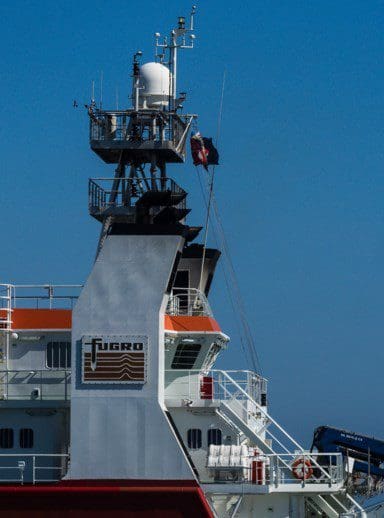
The latest addition to Fugro’s fleet, the geotechnical drilling vessel ‘Fugro Scout’, was baptized last week in Rotterdam by Marian Geise, wife of Joost Geise, commercial director of Fugro Offshore Geotechnics.

Tebma Shipyards delivered Fugro’s new vessel, earlier this year at its shipyard at Malpe, India, following the delivery of its sister ship Fugro Voyager in 2013.

Since its maiden project in the Persian Gulf, the 83-metre vessel has been successfully deployed in the Arabian Sea and the Red Sea, completing several geotechnical and geophysical surveys.

The new vessel is designed for both the shallow and deep water survey markets. It can perform drilling and seabed sampling in water depths up to 3,000 metres.

Fugro Scout’s next mission is to take on a geotechnical survey for an offshore windfarm project in the Dutch sector of the North Sea.

With quarters for up to 60 operational staff, the vessel also comes with a soil laboratory which provides an open-plan working environment for the geotechnicians.


Source

Penspen Wins Engineering Study Off Nigeria

0

Penspen, a provider of engineering and management services to the energy industry, has been awarded a contract from Sirius Group to conduct an engineering study for the monetisation of gas reserves from oilfields offshore Niger Delta.

A key element of this agreement is the development of gas reserves of the OML 122 field, located in the offshore Niger Delta region 40km from the coastline of Southern Nigeria.

The study is being conducted as part of Project Dawn, a three year development project worth US$1.2billion that includes the construction of a pipeline network to deliver natural gas to the Escravos – Lagos Pipeline System (ELPS), which was designed and constructed under the supervision of Penspen more than two decades ago. The gas from Project Dawn will feed power plants and different industrial applications in Nigeria.

Project Dawn is expected to introduce 250mmscf/d of natural gas under the Gas Sale and Purchase Agreement (GSPA) between Sirius Oilfield Support Services and Nigerian Gas Company (NGC) a Subsidiary of NNPC.

The project will include an evaluation of the OML-122 field development, subsea gas pipeline and onshore central processing facility. The study will seek to determine the extent of new pipeline and facilities required, and quantify the overall investment required for the project.

The work is planned to include workshops in Nigeria to cover the screening of options, as well as decision and risk analysis.

Peter O’Sullivan, CEO of Penspen, said: “We are pleased to have been selected by Sirius Group to provide our engineering expertise for this significant study, which will increase availability and improve accessibility to energy across the region. I am confident our team’s reputation and experience in conducting similar engineering studies worldwide will benefit and deliver value in developing infrastructure for Nigeria’s gas network.”


Source

Deep Sea Diving and Commercial Diving

0

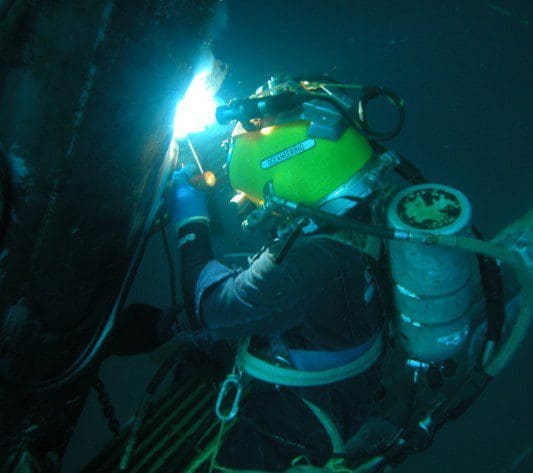
This division of diving is reserved for brave, gritty persons who have a passion for the water and don’t mind getting their hands dirty… very dirty. It’s a serious and dangerous branch way off the beaten track of recreational diving.

The physical demands are so extensive that this group of divers averages working 9 months of the year. It’s essential to be in excellent physical health and skills required other than swimming are advanced mechanical abilities when deep diving. Diving in these two categories are carried out by commercial organizations for purposes such as:

  • Fishing for sea creatures such as sponges, coral, and pearls, molluscs and crustaceans that have a higher value on the market than most, and are protected by certain fishing restrictions in quotas due to marine laws.
  • Civil engineering and general infrastructural maintenance in harbours and docks as well as on bridges, water supply and drainage systems.
  • Examining, inspecting, cleaning and repairing the ships and boats.
  • Recovering sunken ships and their archeologically valuable contents.
  • For Navy purposes and military operations such as reconnaissance and sabotage.
  • Offshore construction and crude oil industry.
  • General fish farm maintenance.
  • Non-Destructive Testing experiments.

The next levels include Diver Medic qualifications by National Association of Diver Medical Technicians. Examples of a training academies in this field are Commercial Diving Academy (CDA) ofJacksonville,  Florida specializing in highly advanced welding training programs and the Divers Institute of Technology in Seattle, Washington was founded in 1968. Today it has grown to the extent where its graduates are qualified to work internationally.Most recently this area has extended to cover salvage and maintenance operations after natural disasters. Training for deep sea diving lasts an average of four to thirteen months. Commercial divingrequires two year training at a vocational school before enrolling in any of the academically advanced areas. In most US schools, divers must have a commercial diver certification and can advance with ASNT certified Level I NDT Technicians.

General subjects learned by commercial divers for qualification include:

  • Non-Destructive Testing and Hazardous Materials Handling and Removal.
  • Underwater Welding and Burning.
  • Photography and underwater closed circuit television.
  • Hydraulic-Tool Training, which was a new technology.
  • Remote Operating Vehicles (ROVs) were introduced for both offshore and inland requirements.
  • Comprehensive 16-week air/mixed-gas course.
  • Mobile Crane Operation
  • Able Bodied Seaman.
  • Diving Medical Technician (DMT).
  • Oil field diving.
  • Safety operations Planning.
  • Underwater construction levels one two and three.
  • Specialized underwater welding courses include modules such as: Safe underwater welding procedures, MMA welding plant & equipment, Underwater welding techniques, Preparing to weld Electrodes & weld terminology, Basic weldability & common weld defects, Monitor & control welding operations, Quality assurance & quality control and Join steel plates using the three standard techniques.

Needless to say, what you put in is what you get out, so promotions are regular. Remuneration is good and travel prospects are also high on the list. It’s not only a demanding career, but the demand for commercial divers is high due to its daring nature.

Qualified divers earn titles such as engineers, instructors, and diving operations supervisors, qualify as AWS Certified Welding Inspectors (CWI), and serve as consultants for underwater welding operations and other related fields.


Source


Seismic Vessel to Become Hotel for OWF Staff

0

Dutch ship owner C-Bed has contracted Wärtsilä Ship Design to supply the design for rebuilding its Seismic Survey Vessel, the ‘Viking II’, for use as a hotel vessel.

According to Wärtsilä, the rebuilt ship will be used to accommodate and transfer service personnel working on offshore wind farms.

The rebuild project is being carried out at the Fayard AS shipyard in Denmark and is expected to be completed during the first quarter of 2016.

Wärtsilä provided the original designs for the ‘Viking II’ earlier known as ‘Veritas Viking II’, which was built and delivered by Mjellem & Karlsen in 1999 to the original owners, Eidesvik of Norway.

However, Eidesvik Offshore’s subsidiary Eidesvik Shipping sold the vessel in August this year and already informed that it won’t be used for seismic ops with the new owner.


The vessel was previously operated by a French seismic contractor CGG.

After the conversion, the vessel will have accommodation and hotel facilities for 125 people and will feature a heave compensated gangway.

The converted vessel will fulfil the requirements for Special Purpose Ships and will in the future be named ‘Wind Innovation’.


Source