Home Blog Page 417

The Underwater Welder: Interview with Jeff Lemire

Jeff answers several questions about his famous creation, The Underwater Welder. We also have a special giveaway that allows you the chance to receive a free signed copy of this graphic novel! See details at the end of this interview to enter.

When did you first become interested in graphic novels, and how old were you when you began working on them?

I started reading comics at a very young age, probably four or five, and have loved them ever since. I’ve been drawing and writing stories for as long as I can remember but have been working in comics professionally for about 10 years now.

Is the protagonist’s characteristics of The Underwater Welder, Jack, directly taken from someone you know?

Not really. Most of my characters end up be amalgamations of different people I know, or outright fictions. Certainly there is more than a little of myself in Jack. Like the character, I was expecting my first child when I started working on the book and it became about that journey of becoming a parent, all the fear, apprehension and excitement that comes with that.

Some of your comic novels are known for their powerfully imaginative environments and characters – what made you decide on such a real and gritty topic like underwater welding? What were some of your influences?

I’ve always been drawn to really “blue-collar” characters. And I don’t say that in any kind of derogatory way. My dad was a farmer and a tool & die maker, as were most of the men in my family. I spent six or seven years working in his tool & die factory during the summers, so being in a work environment like that really influenced the kinds of characters I write.

Underwater welding, specifically, became an interest when I was working as a line cook in a restaurant here in Toronto. The brother of another cook I was working with was going to school to learn underwater welding, and when he told me about it, I was immediately struck by both the visual and thematic potential of it.

Jack Joseph welds offshore on an oil rig. What types of research did you do to learn about the work life of offshore commercial divers?

I wish I had done more, to be honest. At the time, my wife was expecting, so going off and doing intensive hands-on research wasn’t an option. So what I learned was mostly from online research, and what I didn’t know I had to fictionalize. Looking back now, I would do things much differently. If I were doing the book today I’d certainly do much more hands-on research. Real welders will probably laugh at the way I depict things because they are so inaccurate. But I do think it works on an emotional level for the story I wanted to tell.

Jack Joseph can fix just about anything underwater. Have you ever witnessed a diver working on underwater construction or seen video footage?

Video footage yes, I looked at a lot as visual reference and was fascinated by it. But I never saw an underwater welder in person.

The diving suit that Jack Joseph wears has an “old school” appeal to many underwater welders. Did you want the design to reflect the time period of the plot, or mirror other aspects of your story?

The book plays around with time a lot. Time and memory. So I wanted the diving suit to have sort of a retro feel. And those old diving helmets are a lot of fun to draw.

Many of your scenes underwater have lots of gray shades mixed in with the blacks and whites. How does this change the emotional mood?

I deliberately used “washes” of gray tones whenever the character is underwater, and kept the artwork black and white only when he was on the surface.This helped give the underwater stuff a “wetter” look and a more dream-like look, which suited the story and themes. I also used a lot of big open panels underwater as opposed to tighter grid-like layouts on the surface. This was to give the ocean a feel of enormity.

Then, as the character’s life unravels, the “dream-like” feel of the underwater scenes starts to melt into the surface scenes.

Jack Joseph is haunted by the death of his father, who was also a diver. Do you feel that diving can “get in your blood” from one generation to another?

I definitely think it’s the kind of profession that can. In fact, I think a lot of jobs can be like that. We emulate our fathers a lot of times and follow in their footsteps.

After researching this field, what do you feel is the most difficult part of being an underwater welder?

It does seem like there is a lot of time away from family which must be hard, and there is a certain amount of physical danger involved as well.

Award-winning Canadian cartoonist Jeff Lemire is the creator of the acclaimed monthly comic book series Sweet Tooth published by DC/Vertigo and the award-winning graphic novel Essex County published by Top Shelf. He published The Underwater Welder in 2012.

Source

Bombardier Retrains as ROV Pilot Technician: Michael Cooper

Bdr Michael Cooper has served in the Army for 15 years: 13 in the Royal Armoured Core, The Queens Royal Hussars, operating Challenger 2, and for two years as an Unmanned Air Vehicle Commander piloting Hermes 450. Asked to tell us about his civilian qualifications he has obtained during his Service career, he lists:

  • BTEC level 3 – RAPD (Aviation Operations on the Ground)
  • ECDL – BCS (European Computer Driving License)
  • Functional Skills, City & Guilds – English and Maths level 2
  • Modern Apprenticeship – EMTA (Engineering Foundation)
  • NVQ – City & Guilds (Engineering Maintenance)
  • NVQ – EAL (Health & Safety)
  • NVQ – EAL (Basic Engineering Drawing Measuring Marking Out)
  • NVQ – EAL (Basic Engineering Materials)

Using Enhanced Learning Credits for retraining

He tells us that he registered for ELCs, ‘a few years ago while with the QRH, to allow for further education.’ Having highlighted his preferred career path in the ROV industry, he has so far undertaken an impressive array of courses, including SQA ROV Piloting Skills, taken at The Underwater Centre, Fort William.  The course was, he says, ‘very well run’ and offered a good academic/vocational mix, as well as, importantly, the base qualifications required for an ROV pilot/tech in the ROV industry.

Invaluable hands-on ROV piloting and maintenance

‘The classroom-based learning was intense and hard going at first due to my having little or no understanding of the subject matter but, with revision and a lot of home study in the evening, it soon came together and made sense. It was a seven-week intensive ROV Pilot Technician Course, consisting of four weeks’ electronic classroom-based learning (so those without an electrical background could gain the base skills required) followed by a more ROV-orientated three weeks, consisting of basic hydraulic and associated systems, while also gaining invaluable hands-on piloting and maintenance skills with the SAAB Seaeye observation ROV.’

Having taken this course, he is pleased to report that, ‘I now have the skills required of potential employees, and subsequently have found employment in my preferred position.’

Advice for Service leavers

Asked if he has any advice for other Service people registering for or using ELCs, he responds, ‘Make sure you research in-depth your chosen career path and ensure its future viability; also ensure that you submit the correct paperwork in good time to allow for any potential costly errors to be rectified.’

‘Knowing that I have three lots of £2,000 to use in the next ten years to gain further qualifications is nice!’

This article originally appeared in Quest magazine, November 2014, page 28, available to view here.

If you’re leaving the forces and have a background in electronics, engineering, hydraulics or mechanics, then the ROV industry could be looking for you. Find out more about training to be an ROV Pilot Technician here.


Source

Kemp: OPEC’s Other Problem: Weak Demand

0

By now, everyone is aware of the serious threat rising shale output from the United States poses to OPEC. But sluggish demand growth in response to the quadrupling of prices between 2002 and 2012 is at least as a big a challenge for the cartel. Consumption in the developed economies peaked at 50 million barrels per day (b/d) in 2005 and is still just 45 million b/d nine years later, according to the U.S. Energy Information Administration (EIA).

Developing economies consumption has risen by 12 million b/d over the same period (around 9.5 million b/d outside the Middle East). Net growth of 4.8 million b/d over nine years is slower than OPEC and other forecasters expected a few years ago. Oil demand in Asia is not growing quickly enough to offset stagnating consumption in the advanced economies and absorb all the extra supply from shale.

OPEC has confronted this problem before in the early 1980s, when consuming countries took unprecedented steps to reduce demand in response to the oil shocks of 1973 and 1979.

Nuclear power programmes in France and Japan, the conversion of heating systems from fuel oil to gas, stricter fuel economy standards for new motor vehicles, and punitive taxes on motor fuels were all deliberately intended to cut oil consumption.

Slowing demand growth as much as rising supplies contributed to the price crisis in 1986, just as it is now causing a similar problem for OPEC in 2014. Oil consumption (and energy consumption more generally) is strongly responsive to price changes provided they are sustained for long enough. In the short term, the quantity of oil consumed is not sensitive to price changes (the price elasticity of demand is low).

The lack of short-term feedback has misled many commentators to conclude that demand is not responsive to prices at all. But that is wrong.

In the medium and long-term, oil and energy demand is highly responsive to price changes. Price elasticity is a function of time. And time is the most important but under-appreciated variable in analysis and forecasts of commodity markets.

MORE ENERGY EFFICIENCY

Total U.S. energy consumption actually fell in both 1974-75 and again in 1980-82 in response to the oil price shocks (http://link.reuters.com/sen53w).

More broadly, periods of low oil and energy prices in the 1950s and 1960s, and again in the late 1980s and early 1990s, corresponded with rapid growth in U.S. energy consumption.

By contrast, the rising cost of oil in the late 1970s and again in the 2000s brought growth in energy demand to a virtual halt (http://link.reuters.com/ven53w).

In the ten years ending in 1972, a period of low oil prices, U.S. energy efficiency (measured in energy consumption per unit of real GDP) was unchanged.

In 1972, U.S. businesses and households consumed a little over 15,600 British thermal units of energy for every $1 of GDP, according to the EIA.

Energy consumption per $1 of GDP was virtually identical to 1962 once dollar amounts are adjusted for inflation.

In the ten years ending in 1986, however, a period in which oil prices soared, efficiency increased at an average rate of 3 percent every year.

Energy consumption per unit of real GDP plunged from 14,800 British thermal units in 1976 to just 10,800 in 1986.

The pattern has been repeated more recently. Low prices in the late 1980s and 1990s saw average efficiency improvements of just 0.8 percent per year in the decade to 1996. High prices in the 2000s drove efficiency gains of 2.6 percent a year in the decade to 2006, three times as fast (http://link.reuters.com/xen53w).

U.S. efficiency improvements have been mirrored in Europe and Japan, albeit on a more modest scale, because other OECD economies made greater strides in the 1980s and had correspondingly less scope to improve in the 2000s.

Efficiency improvements in developing economies have been smaller because in many cases businesses and households have been sheltered from the full impact of rising oil costs by subsidies and price controls.

In any event, underlying demand for oil and energy is rising rapidly as emerging economies modernise, urbanise and develop a large middle class, which is more than enough to offset efficiency improvements.

But even in developing countries, demand for oil in particular and energy more generally has grown more slowly than predicted five years ago in response to the escalation in costs.

LOWER PRICES NEEDED

The problem is a familiar one for OPEC. “My main worry was that if we increased the price of oil too much we would merely reduce the demand for it in future,” former Saudi Oil Minister Zaki Yamani told his biographer about the acrimonious debate within the cartel over price rises in the 1970s.

“I have always said price increases should come in small doses … Gradual increases can be absorbed. It’s very dangerous for everyone involved when price increases come as a shock.” Yamani explained (“Yamani: the inside story” 1988).

The quadrupling of oil prices between 2002 and 2012 was every bit as much of a shock as the rise between 1973 and 1980, and the response has been the same.

Consumer countries have sought to replace oil with cheaper alternatives (for example biofuels mandates in the United States). Vehicle fuel efficiency standards have been tightened. And businesses and consumers have changed their driving behaviour to cut fuel consumption (improving route planning and cutting back on discretionary journeys).

The result has been the same as in 1986, leaving OPEC with sluggish demand at precisely the same time that rival supplies are surging.

The solution is also the same. Prices must come down and stay down long enough to discourage investment in non-OPEC production and get demand growing strongly again.

But there is one crucial difference between the 1980s and 2010s. In the late 1980s and early 1990s, low oil prices eventually encouraged complacency. The drive for fuel efficiency faded.

In the 2010s, however, the drive for greater fuel economy is linked to climate change as much as rising oil prices. Most of the energy efficiency, conservation and substitution policies enacted since 2005 have had the dual purpose of reducing demand for increasingly expensive oil and curbing greenhouse emissions.

Government support for biofuels, electric and natural-gas powered vehicles, and increased fuel economy were all introduced to support climate change goals as much as energy security. Climate change will give energy efficiency policies much more stickiness than in the 1980s and 1990s.

In that sense, OPEC may face a bigger challenge in using low prices to buy back some of the demand growth lost in recent years. The rapid modernization of developing economies will work in the cartel’s favour, but climate change policy works against it, as OPEC tries to rebalance the market.

Source

SAL in Wikinger OWF Project

0

In October 2014 the first phase of the pile testing campaign for the Wikinger offshore wind farm project was launched after the site’s geotechnical investigation on the Baltic Sea had been completed.

German engineering and services group Bilfinger was awarded the test pile contract and chose SAL Heavy Lift as subcontractor to transport and install the test piles and equipment with their DP Class II vessel MV Lone. Test objectives are to confirm the design of the wind farm foundations by testing the performance of the piles against static, dynamic and cyclic loads specific for offshore structures.

After returning from an oil & gas related project in Angola SAL’s offshore installation vessel MV Lone was set up for the first phase of the pile testing campaign. Initial vessel mobilisation activities took place in Rotterdam in early September. After more mobilisation and loading of project equipment in Rostock and Sassnitz, Germany, the vessel was ready to sail for the field. MV Lone was fitted out with additional living quarters to accommodate the 75 persons necessary for the project. Furthermore, she carried one Work Class ROV and a second observation class unit. Survey was undertaken by a third party utilising the vessel’s facilities including the vessel’s HiPAP.

The full test campaign comprises two phases with the tests being performed at three locations. During the first phase three sets of three piles were driven at designated locations to required depths. In the second phase, pile pull-out tests will be performed with the expectation of minimal movement of the piles. The purpose behind driving piles in sets of three is so that the two outer piles can be used as reaction piles while the pull force is imparted to the central pile. This pull-out test – the second phase – will be conducted 7 to 10 weeks after the piles have been installed. All these tests aim to confirm the soil integrity.

In order to accurately install the three piles in one line SAL’s client, Bilfinger, designed and constructed a purpose-built piling template as the spacing between each pile is critical to the successful outcome of the test programme. The template weighs just under 175 t whilst the piles average at 35 m length and 50 t weight.

According to the company, the pile testing project was technically challenging, not only in terms of methodology design and planning, but also of engineering and ultimately, offshore delivery. The installation engineering, motion analysis, rigging and sea-fastening design were performed by the SAL engineering departments in Delft and Hamburg. Offshore rigging and lifting operations were jointly undertaken by Bilfinger’s and the vessel’s crew. This included placement of the template on the seabed and recovery, lifting, upending and stabbing of piles into the template and lifting and placing of the piling hammer and arrangement.

The installation phase has been essentially concluded with all works at sea having finalised without incidents. For the second phase of the test programme, re-striking of the test piles, along with pull-out tests, SAL Offshore will return to the project site with MV Lone in December 2014.

Source

Australian Market Ripe for Consolidation

0

Consolidation between Australian companies, such as the deal brewing between Neon Energy Ltd. and MEO Australia Ltd., are overdue to become a more common sight on the Australian oil and gas market, according to the CEO of one of the companies.

The merger creates a cashed up junior, with prospective assets, at a time when industry experts believe there are opportunities on the Australian market for increased merger and acquisition (M&A) activity. While a new entity with exploration and production (E&P) exposure has been established, the two companies have been open about intentions to explore more deals.

Neon chief executive officer Ken Charsinsky expects the merger to be completed in the next three or four months now that an unsolicited offer from private Australian investment company Evoworld has been voted down by the company’s shareholders.

Charsinsky said Neon’s cash position of more than $21.6 million (A$25 million), which had grown through the sale of its U.S. assets and a favorable settlement on a liability on assets in Vietnam, put it in the position to look for opportunities. “We found ourselves with quite a bit of cash but no assets so it was the perfect time to pursue opportunities that we had been working on in the background,” Charsinsky told Rigzone.

Just as Neon was going to pursue these deals it was approached with the Evoworld offer, which Charsinsky says for a variety of reasons the company did not want to pursue, even before the offer was blocked by shareholders. “With MEO, the result will be a cashed up junior with good technical team, a story, assets, and cash to do it with during a time when cash is king. We felt it was a very simple, very black and white decision from our point of view,” Charsinsky said.

JUNIOR OPPORTUNITIES

Charsinsky said the deal would be executed at a time when a lot of junior oil and gas companies on the Australian Securities Exchange (ASX) have assets but no way of funding them. “We have been in the opposite situation where we have capital, and that has created the right time for us to go forward as a good company to merge with,” Charsinsky said.

“As a general matter it has been recognised that the Australian energy market has been ripe for consolidation for several years – it really should have happened a long time ago.

“I think now could be the time when we will probably see it happening more. When you have so many small companies not able to realise value from their assets because they are not able to fund them, putting two, three or even four of them together makes a lot of sense.” Johan Hedstrom, senior oil and gas analyst at Canaccord Genuity in Sydney, agreed, saying pressures such as the falling oil price and difficulty to raise capital have created M&A opportunities for junior companies with “better balance sheets”.

“At the smaller end, in like a Neon situation, there are a lot of companies that are very short of cash, and Neon was a bit of an exception there,” Hedstrom told Rigzone.

“I don’t think in my 30 years looking at the oil and gas sector that I have seen so many companies on the ASX that have a market cap below A$20 million ($17.3 million). They are basically saying that cash is going to be wasted on drilling and recent history for exploration drilling has been disappointing – there’s some merit in that argument.”

Hedstrom believes these factors will trigger more M&A to survive whereas small companies are going to “get together”. He said the Neon and MEO combination was a perfect example of a deal that made sense in this market, with “one company having the cash, the other having assets”.

“It will ensure their survival for longer and they are clearly now looking at some acquisition opportunities, most likely production assets or near development. Those sort of opportunities will be coming at the market,” Hedstrom explained.

“I think we are going to see more opportunities at the junior end, in particular. That’s where I think most of the activity is going to be.”

RENEWED ACTIVITY

With the time ripe for more M&A activity between oil and gas companies, there have been signs of growth on the Australian market during 2014.

Australia’s Roc Oil Ltd. was part of a takeover tussle for much of the year, which saw it accept a deal with Chinese company Fosun International Ltd. over a merger with another Australian company, Horizon Oil Ltd. That deal, worth about $332.7 million (A$385 million), finally closed this month and saw Fosun gain oil assets in Australia, Malaysia and the North Sea. 

A month ago, Drillsearch Energy Ltd. completed an acquisition of Ambassador Oil & Gas Ltd. in another takeover battle, this one with U.S. company Magnum Hunter Resources. Ambassador’s major asset was a 47.5 percent interest in the Cooper Basin exploration permit PEL 570. On a smaller scale, Australian-focused Mosman Oil & Gas Ltd. acquired unlisted junior Trident Energy Ltd to gain access to its onshore and offshore interests in the country.

Source

Seaflex, Salvesen Salvage WWII Landing Craft

0

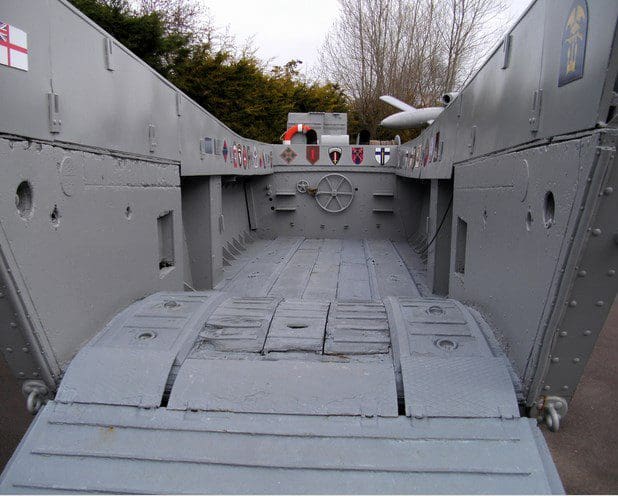
Unique Seaflex (Seaflex), in cooperation with Salvesen UK, deployed 230t of buoyancy as well as a specialist engineering team in the re-floating of the only surviving landing craft from D-Day 1944. The operation took place in Birkenhead Docks Liverpool. 

Ben Board, Technical Site Support Manager at Unique Seaflex commented, “It was a great honour to work with Salvesen on such a prestigious UK heritage project. Whilst we have since diversified into other buoyancy applications for the offshore industry, we built our business on this type of salvage work and it is very much in our own heritage.”

The project to lift and save LCT 7074 began in March 2014, almost exactly 4 years to the day after she had sunk. The vessel came out of service at the end of the WWII after numerous successful deployments to the Normandy beaches; she was converted to a naval repair facility for a short while, then became a floating nightclub, and was berthed in Liverpool from around 1950.

Salvesen UK were engaged by Comet Technical Services on behalf of the National Museum of the Royal Navy to conduct a dive survey and some NDT inspection of the vessel during March. The result of the inspection was the discovery that the hull was deemed in good enough condition to attempt the refloat. A grant of nearly one million pounds was awarded by the National Memorial Heritage Fund and operations recommenced on the 22nd of September.

After three weeks of diving to clean the vessel and prepare her for internal diving operations, the landing craft was ready to be refloated.  The enclosed buoyancy units fitted with pressure release valves were the ideal solution for the refloating of the craft.

Salvesen began by installing 18 x 5t single-connection vertical Unique Seaflex Mono Buoyancy Units into the wing tanks, which run fore and aft, port and starboard.  They then burnt holes either side of the vertical frames in the wing tank bulkheads to secure a further 20 x 5 ton MBUs.  As these units would break the surface before the vessel was fully afloat, the full lift potential of 190t would not be achieved, but it would be supplemented by 8 x 5 ton multiple-connection horizontal Inflatable Buoyancy Units in the main engine room.  They then successfully and safely tunnelled under the vessel’s approximate 10 metres’ beam, creating a 1.5 square metre aperture to allow 2 x 100t soft slings to be inserted; these were then restrained and connected to two spreader beams.

A floating crane was then mobilised to assist with the lift, initially loaded to 50 tons. The lifting bags were then inflated sequentially so as to provide a stable and as controlled lift as possible with the stresses on the vessel being monitored throughout by digital strain gauges at various locations on the hull.  With all the bags inflated, the load on the crane was increased at 5 ton increments, and at 105 tons on the crane the vessel slowly began to rise from the seabed.

After the tank deck level was reached, approximately 400,000 litres of water was pumped out and the vessel was successfully refloated.  All the salvage equipment was then removed from the hull and final preparations made for her transfer to Portsmouth Naval Base for restoration.

Source

Russia Says Will Keep Oil Output Steady In 2015

0

Russian oil companies will keep production steady in 2015, Energy Minister Alexander Novak said on Wednesday, after Moscow left a meeting with other major oil producers with no agreement on how to address weak oil prices. Russia, which is not an OPEC member, has watched nervously as oil prices have fallen 30 percent since June and analysts say Moscow had hoped to convince other members and non-members to support a production cut at an OPEC meeting on Thursday.

After talks between Saudi Arabia, fellow OPEC member Venezuela and oil power Mexico ended without an agreement on Tuesday, Russia’s message was clear – daily average oil production of around 10.5 million barrels will be maintained.

“We have got the plans which companies have embarked on for next year: (output) will be along the same lines as this year,” Novak told reporters. Russia is hoping to keep output stable by exploiting new areas such as the Bazhenov oil formation and Arctic offshore.

Novak, who was in Vienna on Tuesday, also said he was sceptical that OPEC would decide to cut output quotas to shore up oil prices which have fallen to around $78 per barrel.

“We don’t know what decision will be taken tomorrow … Consultations have been going on over recent days … In general, I am sceptical that any decision on output cuts may be taken,” Novak said. Over the last couple of days Russia, which needs price of at least $100 per barrel to balance its budget, has been sending mixed signals to OPEC ranging from a possible slight cut in production to keeping its output flat to help prices.

Despite being among the world’s top three crude oil producers, Russia is limited in its ability to rapidly cut or increase supplies to global markets, with some analysts suggesting it may see a natural decline in output in 2015. Novak said that lower oil prices would close ineffective oil projects, decreasing output to support prices which should return to a “fair level”.

At the same time, he added that Russia would not postpone its Arctic projects, while the Bazhenov oil formation was also continuing even under the current oil price.

Source

Siemens to Pull Out of Tidal Power Industry

0

Siemens is looking to divest its ocean power generation business, in particular Marine Current Turbines (MCT), based in Bristol, United Kingdom.

This restructuring would affect 45 employees in the Hydro & Ocean unit in Siemens Division Wind Power & Renewables. It is expected that the divestment will need several months to be completed.

This proposal follows a strategic review to explore available options for the emerging business.

According to the company, the market and associated supply chain has not developed at the speed that Siemens expected. A dedicated tidal power industry of critical size will develop in the near future. But due to the limited resources it would be a niche market for Siemens. In case negotiations with potential buyers are not successful, Siemens will fully consult with all potentially affected employees. In the event of restructuring then redeployment within Siemens will be prioritised and complete support will be offered for redeployment or outplacement.

Siemens is a significant UK employer with 13,760 employees, including around 2,000 employees in its renewable businesses.

Source

MeyGen Enters Construction Phase

0

After more than seven years of planning and design, Atlantis is now entering the construction phase of MeyGen’s first 6MW tranche of capacity in what the company believes to be the world’s larges planned tidal stream project.

Now that the financing package has been agreed for the first four turbines, Atlantis entered into all the major construction contracts.

A team at ABB is making solid progress and will soon finish the design work relating to the onshore control centre at the Ness of Quoys in Caithness, construction of which is due for completion in September 2015.

Underground installation of the cable to the power distribution network, approximately 12 miles from the site, will start in spring next year and will take a couple of months to complete. This work will be carried out by Scottish Hydro Electric Power Distribution, the network operator, and will enable the company to export clean energy to the grid and onwards to consumers.

The cable supplier, JDR, has received the order for the subsea export cables which connect the turbines to the onshore control centre. The cables will be manufactured at JDR’s plant in Hartlepool in the north of England, and are expected the to be ready for delivery and installation in summer next year.

These quadruple armoured cables, totalling some 11.5km in length, will be laid along the seabed and brought to the onshore control centre though conduits drilled in the rock.

Atlantis’ foundation suppliers will soon place orders for the 5,500 tonnes of steel required to fabricate the foundations and ballast blocks for all of the turbines. These will be fabricated at Nigg, in the Cromarty Firth, and Thurso, close to the project site, and are due to be completed next summer. These foundations rely on gravity to hold them to the seabed, and will remain in place throughout the life of the project. Specially designed connection systems allow the turbines to be installed and retrieved separately so that maintenance can be carried out.

According to the company, MeyGen’s turbine suppliers, AHH and Atlantis, are also progressing well. AHH has placed orders for the generators and gearboxes, which are to be assembled in Andritz’s factory in Ravensburg, Germany and subsequently delivered to Scrabster harbour in 2016.

Source

Raising the Concordia

0

The greatest salvage operation in history was led by one man. Here’s his story.

At first the politicians were saying the refloat of the Costa Concordia would be a seven- or eight-month job at most. It didn’t take long for Nick Sloane, salvage master for Titan Salvage, to set them straight. 

In the end, he was on the job at least 12 hours a day, seven days a week for 27 months. He had a few short weeks off during that time and a few eight-hour days when bad weather forced everyone on the team to accept some respite from the pressures of the job.

ASSEMBLING THE TEAM

At times, Sloane’s team reached 530 people from 26 different countries. It included salvors, scientists, engineers, logistics managers, divers, fabricators, coded welders, finance and commercial teams and many more, each with different skills and different priorities in the project. He needed to be strong and decisive, but he also needed to be mindful of those watching him, including experts from the client’s representative, London Offshore Consultants LOC , the Italian authorities (the vessel was still deemed a crime scene), the Coast Guard, the Osservatorio Committee, the people of Giglio, environmentalists and the media. 

“It was really good to see how they all did come together,” notes Sloane. “At the end of the project, it was a really powerful team, the strongest team I’ve ever worked with. I’ve been fortunate to have always worked with good salvage teams in my career, but this was such a long project. When we had to overcome challenges, it was a case of ‘Let’s just get on with it together.’ Nobody was saying ‘That’s not my scope of work’ or ‘That’s your scope of work.’ It was something we have to do, and a case of anyone who can come up with an idea, stand forward.”

Sloane worked from 7:00 a.m. to around 9:00 p.m. each day. Operations continued around the clock, so this timetable meant he spanned both day and night shifts. Others worked to different schedules. The divers, for example, worked midnight to midday or midday to midnight. “This gave both teams about six hours of daylight, and this meant they performed better over the long term. Otherwise, after a while, people working on night-only shifts become the B team. They don’t get natural light, and it does impact their performance,” he adds.

“It was a very long time to remain focused and to keep people driving on a 24/7 basis. We needed people who would commit for the whole duration. Continuity was paramount to the success of the project. To do that, you have to have enough of a team that you can rotate them and give them a break so they don’t collapse. We had one or two in the early stages who just wore themselves out, and by mid-winter they’d had enough. So we had to make sure we looked after people. The divers were doing two months on, one month off. Some of the others were doing four weeks on and four weeks off. We just had to keep the management team going all the way through.”

Shoreside, there was also a lot of effort going into the operation. “We had over 150 subcontractors, and to manage all that from an island perspective took a powerful logistics and management team on the shore. We liaised back and forth with them every Saturday when we’d integrate what was happening on the mainland and around the shipyards with what we needed on Giglio. That worked pretty well. We identified the logistics demands quite early on as one of the challenges, and fortunately we put the right structure in place to support the operation. We didn’t waste much time, but it was a much bigger structure than we envisaged in May of 2012, when we signed the contract.”

With over 22,000 individual dives conducted, the project was the largest diving job in the history of the industry. A lot of supporting talent was brought in from the offshore industry. The duration of the project was similar to that experienced in the offshore industry as were the challenges of drilling and subsea construction. 

“We used ROVs a lot, and we ended up with over 55,000 hours of ROV recordings. The ROVs made it a lot easier for us to monitor what was going on because we could watch everything from four or five different vantage points. I think monitoring and managing the project was a lot easier as a result. Normally, you don’t get that. I’d certainly use ROVs again and even put them in earlier so that right from day one we’re ready to go with them.”

A lot of effort was put into getting ready for the parbuckle. One of the main challenges was getting the platforms in place. Two-meter-diameter holes were required to meet very tight design parameters, to take the pile legs of the platforms that were being built at three different fabrication yards around Italy from the Adriatic to Tuscany, and tolerances were tight with less than a one percent margin for error. 

“We faced a lot of challenges drilling into the granite. It’s the hardest rock you can get, and drilling at angles of 25 to 35 degrees into a seabed that was uneven was challenging. When you’re trying to drill vertically into the granite, the drill tries to bounce away from it, and we were drilling two-meter-diameter holes with a drill head that weighed around 70 tons. When the drill started turning it would just bounce away until we found a way to stabilize it in position.”

DISAPPOINTMENT AND TRIUMPH

The biggest worry was the winter weather of 2012. “We were battling with the drilling operations after three months of planning and engineering. By the time we started drilling it was late September, and we had bad weather come in. It was one of their worst winters in 45 years, and in one of the storms the ship actually collapsed two meters overnight. That was pretty demoralizing because we weren’t performing on the drilling side, and the weather was knocking us for six. When she dropped she could have buckled further, or even collapsed. We were really worried. We thought she’d never survive the winter.

“By March we were feeling much better, but between October and January morale was down. The client wasn’t happy; the local population wasn’t happy. There was a lot of pressure on everyone at that time and we just had to find the solutions. It was nerve-wracking. We didn’t sleep too much. The weather was bad; we tossed and turned, and we were really worried if the phone rang.”

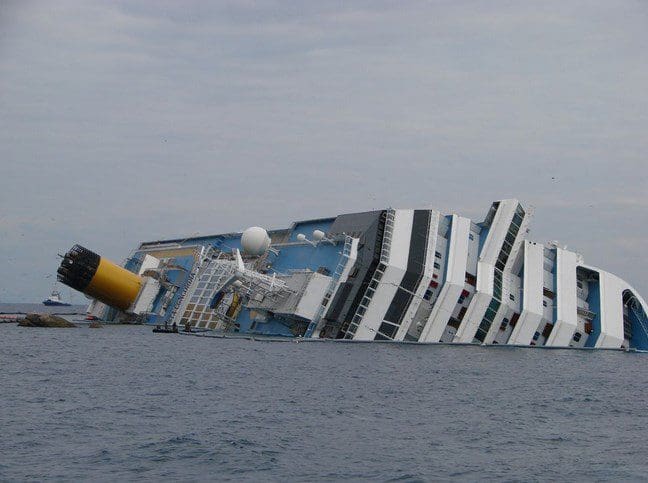
Certainty is required in salvage, so the team prepared for the parbuckling assuming the vessel would be heavier than expected and assuming the damage on the starboard side was so bad that there would be no straight surfaces on the ship’s side-shell. This meant that divers connected the starboard sponsons by chains rather than welding them. The chains (there were 56 of them) ran under the vessel, which was lying at an angle of 65˚ to starboard, and the divers sometimes faced rough seas while they worked. Five-meter swells halted progress at times.

One of the biggest risks was that the bow could come off during the parbuckling operation. Specially designed blister tanks were made to support it. “That was something many people feared was impossible – to design, fabricate and deliver the tanks before the parbuckle date, but we knew the benefits. Without them, there was little chance of the parbuckling being successful.”

That success was a turning point in the project. “The best moment was certainly the parbuckling. All the earlier challenges came together in that 19-hour period, and the results were spectacular. It was much better than we were hoping for. We’d allowed ourselves to have quite a bit more damage from the operation, but it actually went like a textbook. When that happened and we knew the ship was still strong enough to allow us to put these forces on it, we knew the most difficult part of the project was over.”

After the parbuckle the team had a big barbie. They invited about 200 people and about 500 arrived. “The whole island wanted to celebrate with us.”

Tourism makes up most of Giglio’s revenue, and everyone on the island was concerned about environmental impacts. It was top on the agenda for Titan too, and Sloane went to extremes to build in safeguards and mitigate any risks. Water quality and noise were monitored on a daily basis.

“I don’t think it prolonged the operation much, but it meant that we put in a lot more effort and resources just to maintain the pristine quality of the water. At the end, when they did the final inspection, everyone was pleasantly surprised. There was a lot of debris that fell out of the ship from the winter weather period, but from the drilling operation there was very little impact. Just after parbuckling we saw the first dolphins we’d seen since the incident swim into the bay.”

THE HANDOVER

Second to the triumph of the parbuckling for Sloane was the delivery to Genoa. There was no time for those involved in the towing operation to party as the wreck sailed away from Giglio, but it was an emotional time for the people of the island. “At some stages, they had almost given up hope of ever seeing it go in one piece, so the day we sailed away they had a big party on the island, another barbie. It was such a big event that they all took the next day off. 

“Although we weren’t there, it was still special to sail away while all the tugs were blowing their horns, and the church bells ringing. Once we were finally alongside in Genoa and the last line was secured, that was the end of our function. Obviously we had to stay there for another week and hand over, but everyone was thinking about getting home and carrying on with their lives again.”

Sloane is currently enjoying home life and some rounds of golf. “It was really enjoyable to be part of such a project, but I’m not sure if I’m ready to start another one tomorrow. Hopefully it will be a while before the phone rings again.” 

Wendy Laursen is the MarEx News Editor for Asia Pacific.

Source